Digital Products & Product Data
The Case for Standardized Product Dimensions in an Agentic-Shopping World
Why AI shopping agents fail on free-text dimensions, and how structured bounding boxes, clearance data, and unit consistency prevent product hallucination.
Furniture brands have been publishing dimension drawings for decades.
A typical chair page might show a clean line drawing with arrows indicating: - overall width; - overall depth; - overall height; - seat height; - arm height.
To a person, the drawing seems perfectly clear.
We look at the arrow.
We look at the number.
We understand where the measurement begins and ends.
We know which line belongs to which dimension.
And because we've seen similar diagrams hundreds of times, we silently interpret conventions the image never actually explains.
But now there is another potential reader of that product page:
an AI shopping agent.
And that raises a deceptively simple question:
Does a dimension image tell a machine the same thing it tells a person?
Not necessarily.
Humans Don't Just Read Dimension Drawings
We interpret them.
Imagine a lounge chair with four dimension callouts:
32"
35"
29"
18"
A person can probably determine that these refer to: - width; - depth; - overall height; - seat height.
But how?
The pixels themselves don't necessarily contain labels saying:
overall_width = 32 inches
Instead, the person interprets: - arrow direction; - leader lines; - drawing orientation; - reference points; - proximity; - furniture conventions; - visual hierarchy.
We fill in the relationship between the number and the object.
That is surprisingly sophisticated spatial reasoning.
Now Ask an Agent the Same Question
A shopper tells an AI agent:
Find me an upholstered chair less than 32 inches wide, with a seat height between 17 and 19 inches.
The agent reaches a product page containing one dimension infographic.
The image clearly shows:
31.5"
and
18"
But the values exist only inside the image.
For the agent to recommend the chair confidently, several things have to happen correctly.
It must:
- access the image;
- detect the text;
- read the number correctly;
- identify the measurement line;
- determine its start and end points;
- understand the drawing's orientation;
- infer what physical characteristic the line represents;
- associate the value with the correct product attribute;
- interpret the unit correctly;
- compare the result with the shopper's constraint.
A human does most of this without thinking.
For a machine, these are separate perception and reasoning problems.
The Problem Isn't Whether AI Can Read Numbers
Modern multimodal models are remarkably capable.
They can read text from images.
They can interpret diagrams.
They can answer questions about spatial relationships.
But can is different from should have to.
Current research continues to identify limitations in vision-language systems when they must reason precisely about structured visual information.
Researchers evaluating vision-language models on charts have found that models can produce fluent high-level explanations while still making factual errors and hallucinating details.
Other work identifies a perception bottleneck: even when relevant information exists visually, the model may fail either to encode it correctly or to extract the necessary information from its visual representation.
Research into visual arithmetic has similarly shown that seemingly straightforward tasks such as comparing lengths remain challenging for vision-language models.
And spatial-reasoning research has found that models continue to struggle with relationships involving distance and physical dimensions.
None of this means AI cannot understand a furniture dimension drawing.
It means:
We're asking the model to solve a visual-reasoning problem when the brand already knows the answer.
That may be unnecessary.
The Apparel Industry Already Has a Version of This Problem
Apparel provides a useful parallel.
Historically, brands often presented sizing information through a size chart.
A person opens the chart and interprets:
| Size | Chest | Waist |
|---|---|---|
| S | 36–38 | 30–32 |
| M | 38–40 | 32–34 |
It works reasonably well for people.
But companies working on AI-driven fit systems have begun arguing that this is not enough for agentic commerce.
The problem is that sizing information was historically formatted as an interface for a shopper, rather than as structured product information that a machine can reliably reason over.
The proposed solution is not:
Make a prettier size chart.
It is:
Define the actual measurements explicitly and consistently.
Furniture has essentially the same problem.
A Dimension Drawing Is an Interface
This distinction is important.
The drawing is a presentation of dimensions.
It is not necessarily the authoritative dimension system itself.
A diagram might show:
18"
A structured product specification should be able to say:
Measurement: Seat height Value: 18 Unit: in Reference: Finished floor to top of compressed/uncompressed seat surface, according to the manufacturer's measurement convention
Now the value has meaning independent of the picture.
That is much more useful to a machine.
And frankly, it can be much more useful to a person as well.
Furniture Has a Vocabulary Problem
Furniture measurements seem standardized until you compare enough product pages.
One company says:
Width
Another says:
Overall Width
Another:
W
Another:
Product Width
Another:
Outside Width
Those may all mean the same thing.
Or they may not.
Then consider:
Seat depth
Where does the measurement begin?
The front edge of the cushion?
The front edge of the frame?
The front of the usable sitting surface?
Does it extend to the back cushion?
To the back frame?
What if the back cushion is loose?
Humans often tolerate these ambiguities.
Machines need clearer definitions.
Arm Height Is an Even Better Example
Imagine two chairs.
Both say:
Arm Height: 25 in
But one manufacturer measures:
floor → highest point of arm
while another measures:
seat surface → top of arm
Those are not the same attribute.
The number alone isn't sufficient.
The important information is:
what was measured
from where
to where
in what unit.
Standardization Starts With Named Fields
For a dining chair, a useful product-dimension vocabulary might include: - overall width; - overall depth; - overall height; - seat width; - seat depth; - seat height; - arm height from floor; - arm height from seat; - back height from seat; - leg clearance; - product weight; - weight capacity.
Not every product requires every field.
A dining table needs a different set.
A sofa needs another.
A cabinet needs another.
The important principle is:
The same physical concept should have the same name every time.
Then Standardize the Reference Points
This is the part that dimension drawings often leave implicit.
Consider:
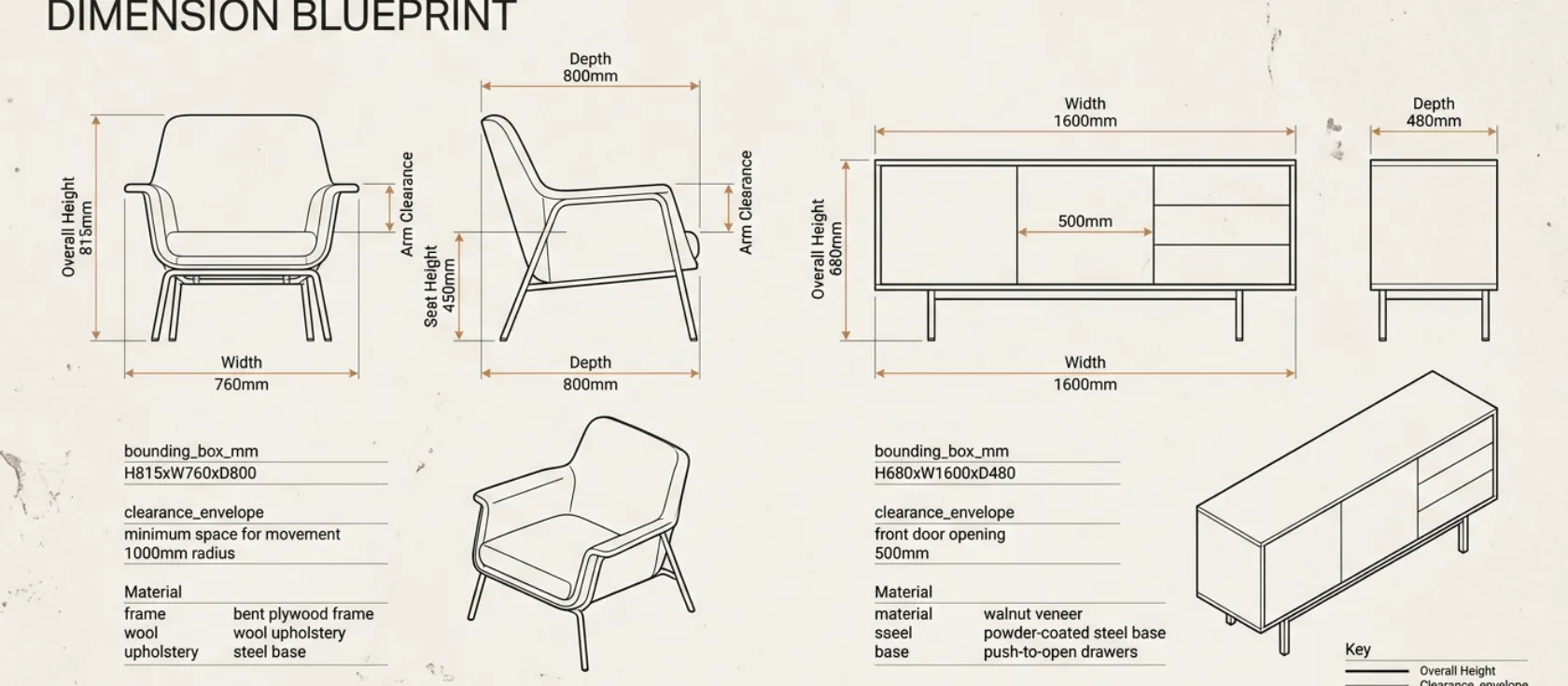
Overall Height
Reference A: finished floor
Reference B: highest fixed point of product
Seat Height
Reference A: finished floor
Reference B: top of sitting surface
But even this raises another question.
Is the cushion: - unloaded? - compressed? - nominally compressed?
That definition matters if different manufacturers are going to be compared.
Overall Width
Reference A: furthest left physical point
Reference B: furthest right physical point
Overall Depth
Reference A: furthest front physical point
Reference B: furthest rear physical point
Suddenly the measurement system becomes much less ambiguous.
The Image Should Follow the Same Convention
Once the underlying measurement vocabulary is standardized, the dimension image can become standardized too.
Imagine every dining chair in a catalogue using:
Front View
Displays: - overall width; - seat width; - overall height; - seat height; - arm height.
Side View
Displays: - overall depth; - seat depth; - back angle where relevant; - clearance.
Consistent Styling
Every image uses: - identical line weights; - identical arrow styles; - identical measurement positions; - identical unit formatting; - identical naming; - identical reference-point logic.
Now the visual language becomes predictable.
For a human, that's easier to read.
For a machine, it may also reduce the amount of interpretation required.
But Here Is the Important Part
The standardized image should not be the only place the dimensions exist.
If the page says:
Dimensions
Overall width: 31.5 in Overall depth: 34 in Overall height: 30 in Seat width: 22 in Seat depth: 21 in Seat height: 18 in Arm height from floor: 25 in Product weight: 42 lb Weight capacity: 300 lb
then the shopping system doesn't need to derive those values from leader lines in a JPEG.
The image still helps.
But the image becomes evidence and explanation, rather than the only container of the fact.
Don't Make the Agent Read the Ruler
This may be the simplest way to describe the principle.
If your company already knows:
Seat height = 18 inches
why publish that fact only in a format that requires a machine to visually reconstruct it?
Don't make the AI: - locate the number; - follow the line; - identify the object; - infer the dimension; - infer the unit.
Tell it:
Seat height: 18 inches.
Then use the image to show the shopper what that measurement actually means.
Text and Image Should Agree
This creates another important requirement.
The dimension infographic and the written specification need to be generated from the same source of truth.
Otherwise something worse happens.
The image says:
31.5 in
The product description says:
32 in
The retailer feed says:
31 in
The PDF says:
800 mm
Which one should an agent believe?
Which one should the customer believe?
This is not an AI problem.
It is a product-information problem.
One Dimension, One Authoritative Value
Ideally, the workflow looks like:
AUTHORITATIVE PRODUCT DATA
↓
overall_width = 800 mm
↓
produces:
Website Specification
800 mm / 31.5 in
Dimension Graphic
31.5"
Retailer Feed
800 mm
Product PDF
800 mm / 31.5 in
API
overall_width: 800
unit: mm
Now every channel is describing the same product.
The image and text are outputs from the same fact.
This Is Where 3D Can Help
A controlled 3D product asset can make standardized dimension imagery much easier to produce.
If the geometry is accurate, the system already knows where important points are located spatially.
A product pipeline can then potentially define:
measurement anchors
such as: - leftmost extent; - rightmost extent; - floor plane; - seat surface; - highest point; - front extent; - rear extent.
Those anchors can support both: - structured dimensions; - consistent visual callouts.
The dimension image is no longer manually drawn around every SKU.
It becomes another output of the digital product system.
Imagine This Across 5,000 Products
This is where the operational value becomes significant.
Suppose a furniture brand has:
5,000 SKUs.
Historically, dimension drawings may have been created: - by different suppliers; - in different software; - over different years; - using different conventions; - with different labels; - in different units; - using different camera views.
The result is technically complete but structurally inconsistent.
Now imagine rebuilding the system around category-specific templates.
Every dining chair uses one convention.
Every sofa uses another.
Every dining table uses another.
Every casegood uses another.
Now the catalogue begins speaking a consistent visual and semantic language.
This Is Bigger Than AI
There is an important point here.
Even if shopping agents disappeared tomorrow, this would still be useful.
Standardized product dimensions help: - customers; - retailers; - designers; - architects; - sales teams; - ecommerce teams; - marketplaces; - customer service; - specification teams.
Agentic commerce simply exposes how much interpretation our existing systems expect users to perform.
The Agentic-Commerce Version of the Question
A shopper may soon ask:
Find me a lounge chair no more than 30 inches wide because it has to fit between my fireplace and a bookcase.
Or:
Find a sofa with an arm height below 25 inches so it fits under my window.
Or:
Find a dining table where the apron leaves at least 27 inches of knee clearance.
Those are not keyword searches.
They're constraint problems.
The agent has:
Shopper constraint
overall_width <= 30 in
and needs to compare it against:
Product attribute
overall_width = ?
If the authoritative product dimension exists only as a visual annotation, the agent may have to extract and interpret it.
If it exists as explicit product information, comparison becomes much more straightforward.
Dimensions Are Really Constraints
That's the deeper shift.
For a human ecommerce page, dimensions are informational.
For an agent, dimensions can become decision variables.
The agent can reason:
Available space
minus
product width
=
remaining clearance
Or:
window sill height
versus
sofa arm height
Or:
elevator opening
versus
packaged product dimensions
This is where standardized dimensions become much more than ecommerce copy.
They become computational inputs.
Weight Capacity Is Another Good Example
A product page may currently show:
Weight Capacity: 300 lb
That sounds straightforward.
But what does it actually mean?
For a bench:
300 lb total?
or
300 lb per seat?
For shelving:
per shelf?
or
total unit?
For a table:
static load?
or
recommended working load?
Again:
A number isn't enough.
The field definition matters.
Units Matter Too
Furniture is sold globally.
That means dimensions may appear as: - inches; - feet; - millimetres; - centimetres.
An agent can convert units.
But the source value still needs to identify its unit correctly.
850
is meaningless without:
850 mm
or:
850 cm
or:
850 in
Explicit units remove unnecessary ambiguity.
The Product Page Should Serve Two Readers
The future product page may need to communicate the same product information in two complementary ways.
For the Human
Show: - clear dimension diagram; - furniture in context; - scale; - readable labels; - visual hierarchy.
The question is:
Will this fit in my space?
For the Machine
Provide: - named fields; - numeric values; - units; - definitions; - consistent category terminology; - explicit reference points.
The question is:
Does this product satisfy the user's constraint?
One Is Not a Replacement for the Other
This is crucial.
We're not arguing:
Replace dimension images with data tables.
A good dimension drawing explains spatial relationships in a way a column of numbers cannot.
And we're not arguing:
AI can't understand diagrams.
Multimodal systems clearly can.
The point is much simpler:
Don't require visual inference when the authoritative value already exists.
Publish both.
A Practical Standard for a Furniture Brand
For every product category:
Step 1 - Define the Required Fields
Example: dining chair. - Overall Width - Overall Depth - Overall Height - Seat Width - Seat Depth - Seat Height - Arm Height From Floor - Product Weight - Weight Capacity
Step 2 - Define Every Measurement
For example:
Seat Height
Vertical distance from finished floor to the top of the unloaded sitting surface at the defined measurement point.
Step 3 - Define the Reference Points
Make them unambiguous.
Step 4 - Select the Canonical Unit
For example:
mm
Convert to display units as needed.
Step 5 - Create the Visual Template
Use consistent: - views; - callouts; - arrows; - order; - typography; - formatting.
Step 6 - Publish the Values as Text
Do not leave them exclusively inside an image.
Step 7 - Generate Every Channel From the Same Values
Website.
Dimension drawing.
Specification sheet.
Retail feed.
Marketplace.
API.
Catalogue.
They should all agree.
Suggested SEO Information
SEO Title: How Should Furniture Dimensions Be Structured for AI Shopping Agents?
Alternative SEO Title: Furniture Dimension Drawings Weren't Built for AI Shopping Agents
Suggested URL:
/furniture-dimensions-ai-shopping-agents/
Meta Description: Furniture dimension drawings were designed for people, not AI agents. Learn why standardized measurements, reference points, and explicit dimension data could matter in agentic commerce.
Primary Topic: furniture dimensions for AI shopping agents
Related Topics: - furniture dimension standards - agentic commerce furniture - AI shopping furniture - product dimensions ecommerce - dimension callout standards - AI-readable product dimensions - furniture specification data - machine-readable furniture dimensions
Core Position
A dimension image helps someone understand where a measurement is.
A dimension value tells a system what the measurement is.
In an agentic-shopping world, furniture brands should provide both.
And the underlying rule is even simpler:
Don't make the agent infer information your company already knows.
Frequently asked questions
Can AI Read Furniture Dimension Images?
Modern vision-language systems can often read text and reason about diagrams. However, current academic research still identifies limitations in chart interpretation, spatial reasoning, visual arithmetic, and extraction of precise numerical relationships from images. For commercially important measurements, brands should therefore avoid making the image the only source of the value.
Should Furniture Dimensions Be Written as Text as Well as Shown in an Image?
Yes. The dimension diagram helps a person understand *where* a measurement applies. Explicit text establishes *what the value is*. Using both reduces ambiguity.
What Furniture Dimensions Should Be Standardized?
It depends on product category. Common examples include: - overall width; - overall depth; - overall height; - seat height; - seat width; - seat depth; - arm height; - clearance; - product weight; - weight capacity. The important part is defining each field consistently.
Why Are Reference Points Important?
Because labels such as **seat depth** or **arm height** can be measured differently. A useful specification defines where each measurement begins and ends.
Should We Use Inches or Millimetres?
Either can be displayed to customers. Internally, using one canonical measurement system and converting it consistently can reduce errors. The unit should always be explicit.
Does Structured Dimension Data Replace Dimension Drawings?
No. They solve different problems. The drawing explains spatial relationships. Structured dimensions provide explicit product facts. The strongest system uses both.
Why Does This Matter for AI Shopping Agents?
Agents may increasingly answer constraint-based shopping requests such as: > Find a chair under 30 inches wide. To evaluate that request reliably, the agent needs to know which product value represents **overall width**, its numerical value, and its unit. Explicit fields remove unnecessary visual inference.
Tell us what you are working on.
Send an idea, a drawing, a sample or a whole assortment. We will identify what is missing and the right next step.
Start a conversation