The Future of Commerce
Can AI Predict Which Products Will Succeed?
AI cannot reliably tell you which product will win, but it can significantly improve your odds. Discover how to use AI as a decision-support system before committing capital to tooling.
AI can help predict which products are more likely to succeed.
But it cannot reliably tell you which product will win.
That distinction matters.
Retailers and brands now have access to more signals than any product team could reasonably evaluate manually: search behavior, sales history, customer reviews, returns, pricing, competitors, social trends, materials, colors, product attributes, regional preferences and thousands of other data points.
AI can process those signals at extraordinary scale.
What it cannot do is remove uncertainty from product development.
A product still has to be designed, manufactured, priced, merchandised, stocked, presented and delivered well. A strong concept can fail because the price is wrong. A commercially ordinary product can become a bestseller because it solves the right problem at exactly the right moment.
So the useful question is not:
Can AI tell us which product will succeed?
It is:
Can AI improve our probability of choosing products that succeed?
The answer to that question is yes.
Product success has never been completely predictable
Product development has always involved uncertainty.
A retailer might review trends, examine previous sales, visit trade fairs, study competitors, speak with factories and rely on experienced buyers and designers.
Then it makes a decision.
Sometimes that decision produces a bestseller.
Sometimes it produces inventory nobody wants.
The problem is especially visible in Home & Living because products can carry significant commitments in tooling, minimum order quantities, freight, warehousing and photography before meaningful customer demand is known.
The traditional response has often been to spread the risk.
Develop more products.
Buy smaller quantities where possible.
Put them into the market.
See what sells.
Then reorder the winners.
That is essentially a spray-and-pray model of product development.
AI offers something more useful than simply generating more things to test.
It gives product teams an opportunity to improve the decisions made before production.
AI can see more signals than a product team can
Imagine deciding whether to introduce a new dining chair.
A human team might consider: - previous chair sales; - target retail price; - competitor products; - current material trends; - customer preferences; - assortment gaps; - manufacturing cost; - margin.
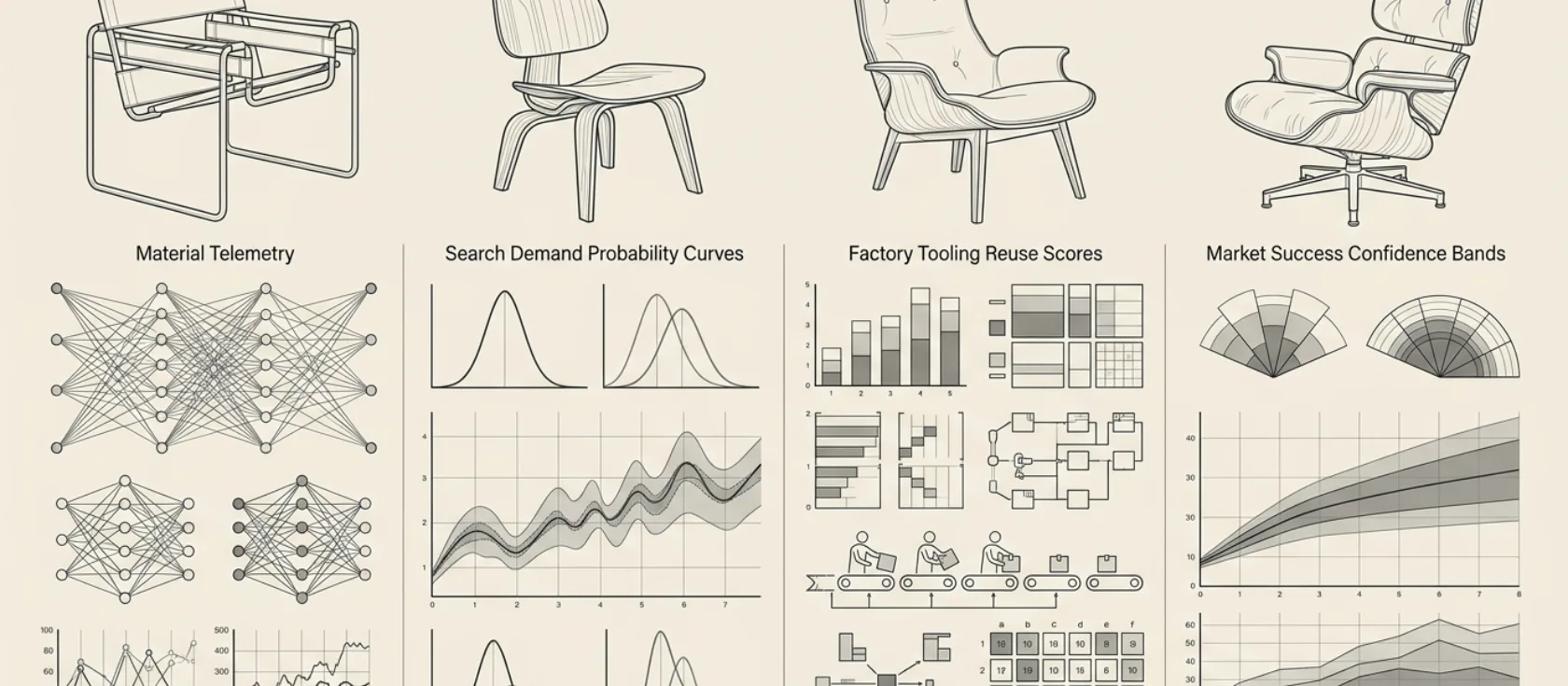
An AI-supported system could potentially evaluate those signals alongside: - search demand; - conversion by product attribute; - review sentiment; - return reasons; - discount dependency; - geographic performance; - color and finish performance; - product dimensions; - visual similarity across the existing assortment; - competitive assortment density; - promotional performance; - lead times; - stock-outs; - historical launch performance; - customer-service feedback; - social and visual trend signals.
The advantage is not that AI magically knows the answer.
It is that it can examine relationships across far more information than a person can hold in their head simultaneously.
Patterns become visible.
And those patterns can improve the decision.
Prediction is not the same as probability improvement
This is the distinction product teams should care about.
A prediction says:
This chair will be a bestseller.
Probability improvement says:
Given what we currently know, this chair has stronger evidence supporting it than these other twelve concepts.
The second statement is far more useful.
Suppose a retailer normally develops twenty concepts to find five commercially strong products.
If better information allows the team to identify weaker propositions earlier, it may be able to concentrate design, engineering, sampling and merchandising resources on ten stronger candidates instead.
AI did not predict the future.
It improved the quality of the decisions leading into it.
That can still create enormous commercial value.
The goal of AI in product development should not be certainty. It should be better odds.
AI can help answer different product questions
"Will this product succeed?" is actually several questions disguised as one.
Is there evidence of customer demand?
AI can analyze search behavior, reviews, customer language, sales data and broader market signals to identify needs and patterns.
Does this product fill an assortment gap?
An assortment can be analyzed by category, price, material, dimensions, style, color, function and other attributes to identify areas that are overcrowded or underrepresented.
Is the product sufficiently differentiated?
Computer vision and structured product data can help identify products that are extremely similar to existing SKUs or competitors.
That matters because adding another nearly identical product may simply divide existing demand rather than create new demand.
Is the price plausible?
Historical sales, competitor pricing, product attributes and customer behavior can help establish whether a proposed price sits inside a credible commercial range.
What are customers telling us about existing products?
Reviews and returns contain enormous amounts of product-development information.
Customers may repeatedly describe a sofa as too firm, a dining chair as difficult to assemble, a side table as smaller than expected or a finish as different from the photography.
AI can process those comments at scale and convert unstructured feedback into usable product signals.
Which concepts deserve further investment?
This may be the most valuable application.
AI can help teams prioritize where human design and development effort should go.
That is very different from asking AI to design a hundred products and hoping one succeeds.
More AI-generated concepts do not necessarily improve the odds
Generative AI has made ideation extraordinarily cheap.
A team can now generate hundreds of plausible furniture concepts in the time it once took to sketch a handful.
That sounds like an advantage.
It can also make the problem worse.
If the organization has no strong system for evaluating those concepts, it has simply created a larger pile of decisions.
The bottleneck moves from:
How do we generate enough ideas?
to:
How do we know which ideas are worth developing?
That is why AI-generated product development needs constraints.
Customer.
Price.
Assortment role.
Factory capability.
Materials.
Manufacturing process.
Channel.
Brand.
Commercial objective.
Without those constraints, AI can generate almost infinite possibility.
But possibility is not product strategy.
Learn: Why Do Constraints Make Better Products?
Historical sales data is useful, but it can also trap you in the past
There is another problem with prediction.
If an AI system learns primarily from products that have already sold, it can become very good at recommending versions of yesterday's winners.
That is useful for some decisions.
It is dangerous for others.
A genuinely new product may have little historical evidence supporting it precisely because it is new.
Changes in culture, technology, housing, demographics and customer behavior can create needs that do not appear neatly in historical sales data.
Human judgment remains important because product strategy sometimes requires asking:
What is changing?
rather than:
What sold before?
The strongest system therefore combines evidence with interpretation.
AI can identify patterns.
People still have to decide what those patterns mean.
AI cannot see the entire product system unless you give it the entire product system
This is where product prediction becomes much more interesting.
Imagine two visually similar coffee tables.
AI identifies both as fitting an emerging style trend.
Customer demand appears comparable.
The target price is similar.
From a market-data perspective, they look equally promising.
But Product A requires unfamiliar tooling, a difficult finish, a new component supplier and inefficient packaging.
Product B uses material the existing factory buys every day, established tooling, proven construction and a carton that already fits the retailer's logistics system.
They are not equally good product decisions.
The commercial outcome depends on information outside the trend forecast.
This is why Vux & Hoy treats product development as a connected system.
Strategy → Design → Engineering → Digital Product → Commercialization
Customer demand matters.
So does manufacturing.
So does cost.
So does packaging.
So does imagery.
So does inventory.
So does the way the product enters the market.
An AI system becomes more useful as more of those realities become structured inputs rather than invisible context.
Learn: What Is Factory-First Product Development?
The product itself is only part of what determines success
This also explains why no product-success model can be perfectly predictive.
Customers do not encounter an isolated product concept.
They encounter:
the product + price + availability + imagery + merchandising + reviews + delivery promise + brand + timing + competitive environment.
Change one of those variables and the outcome can change.
A strong product with poor imagery may underperform.
A good product that is repeatedly out of stock cannot reach its potential.
An excellent chair at the wrong price can fail.
A mediocre product can temporarily outperform because it receives disproportionate promotional exposure.
This makes product success a systems problem rather than simply a design problem.
The goal should therefore be to improve the probability of success across the system.
AI can make product teams more selective, not less
One of the most interesting possibilities is that AI allows companies to make fewer, better-informed bets.
Generative AI is often presented as a way to increase output:
more concepts;
more variants;
more content;
more products.
But greater volume is not automatically greater value.
The more commercially interesting use may be elimination.
Use AI to identify duplication.
Use it to find weak differentiation.
Use it to expose poor customer sentiment.
Use it to detect assortment gaps.
Use it to compare proposed products against historical performance.
Use it to identify where a concept conflicts with manufacturing or price constraints.
Then concentrate human attention on the opportunities that survive.
That changes AI from an idea generator into a decision-support system.
And that may ultimately be far more valuable.
What should humans still decide?
AI can provide evidence.
It should not automatically own the product decision.
Experienced product teams understand context that may not exist cleanly in the data: - where the brand wants to go; - which customer it wants to attract next; - what a factory can genuinely execute well; - where quality problems are likely to emerge; - whether an emerging aesthetic has cultural longevity; - what makes a product emotionally desirable; - when an unusual idea is worth taking a risk on.
There is also a fundamental strategic choice that data cannot make for you:
What kind of company do we want to become?
An algorithm can optimize against an objective.
People still have to choose the objective.
So, can AI predict which products will succeed?
Not with certainty.
And that is probably the wrong standard.
AI can help retailers and brands understand more evidence before committing capital to a product. It can identify patterns across information that would be difficult to evaluate manually. It can expose weak ideas earlier, identify assortment opportunities, analyze customer feedback and help prioritize concepts for further development.
But commercial success still emerges from the interaction between customer demand, design, engineering, manufacturing, price, inventory, merchandising and commercialization.
AI does not need to replace that system to be transformative.
It needs to help the system make better decisions.
The future of AI in product development may not be predicting the winner. It may be dramatically improving the odds that we choose one.
Frequently asked questions
Can AI predict which products will succeed?
AI cannot reliably predict which specific product will win, but it can significantly improve the probability of choosing successful products. By evaluating search demand, sales history, customer reviews, return reasons, and competitive density, AI helps teams prioritize stronger concepts before production.
How does AI improve decision odds in product development?
AI processes thousands of market and customer signals simultaneously, identifying patterns across price points, dimensions, materials, and styles. This allows teams to eliminate weak or duplicate propositions early and focus capital on high-probability designs.
Can AI assist with product assortment planning?
Yes. AI analyzes category distribution, pricing tiers, material options, and customer preferences to uncover gaps where demand is underserved and highlight overcrowded segments where new products would merely cannibalize existing sales.
Why is generating more AI concepts not always an advantage?
Generating hundreds of visual concepts without commercial constraints creates a bottleneck of unvetted options. AI is most effective when used as a decision-support tool that filters concepts against manufacturing, cost, and brand realities.
What are the limitations of historical sales data in predicting trends?
Historical data reflects past customer behavior and cannot foresee cultural shifts, emerging lifestyle needs, or breakthrough designs. Successful product development balances historical data analysis with forward-looking human design judgment.
What role should humans retain in AI-assisted product development?
Humans set the strategic direction, define brand objectives, interpret emotional desirability, assess manufacturing feasibility, and decide when to challenge conventional data patterns to pursue genuinely innovative products.
Tell us what you are working on.
Send an idea, a drawing, a sample or a whole assortment. We will identify what is missing and the right next step.
Start a conversation