Digital Products & Product Data
Do You Still Need 3D Product Models in the Age of AI?
Why generative AI makes precise 3D CAD and digital twins more necessary than ever for ecommerce accuracy, spatial commerce, and preventing product hallucination.
The short answer? Jein. Yes and no.
AI image generation has changed product visualization dramatically. Today, it is possible to take a photograph - or even a handful of simple product images - and use generative AI to create beautiful environments, marketing concepts, and lifestyle imagery faster than ever before.
So a reasonable question we hear from clients is:
If AI can generate the image, why do we still need a 3D model?
The answer depends on what you want the asset to do.
If you need one compelling image, AI may be enough.
If you need a product visualization system that remains accurate, editable, and reusable across campaigns, configurations, viewpoints, and future applications, 3D still has a very important role.
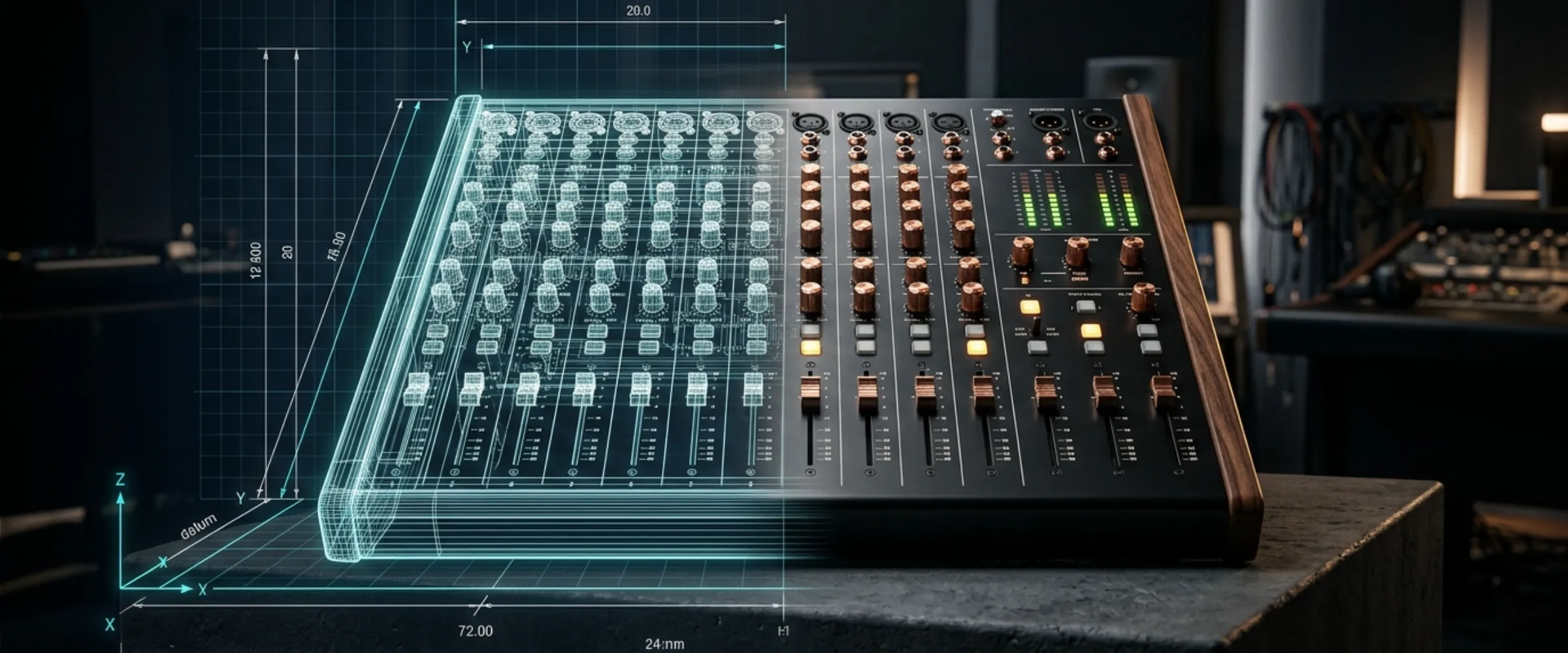
AI Creates an Image. 3D Creates a Source of Truth.
A photograph captures a product from one particular viewpoint at one particular moment.
An AI-generated image is also ultimately an image. Generative systems can interpret reference imagery extremely well, but they are reconstructing or generating visual information rather than consulting an authoritative geometric definition of the physical product.
A properly constructed 3D asset is different.
It contains information about the product itself: - geometry; - proportions; - components; - materials; - relationships; - spatial structure.
That makes the 3D model something closer to a digital source of truth.
Once that source exists, we can render: - a front view; - a rear view; - a close-up; - a white-background ecommerce image; - an architectural lifestyle scene; - a different finish; - a different camera angle; - an animation; - an interactive configurator; - AR or spatial content;
without reinventing the underlying product every time.
The image changes.
The product does not.
The Challenge With Generative AI Is Consistency
This is where the distinction becomes important.
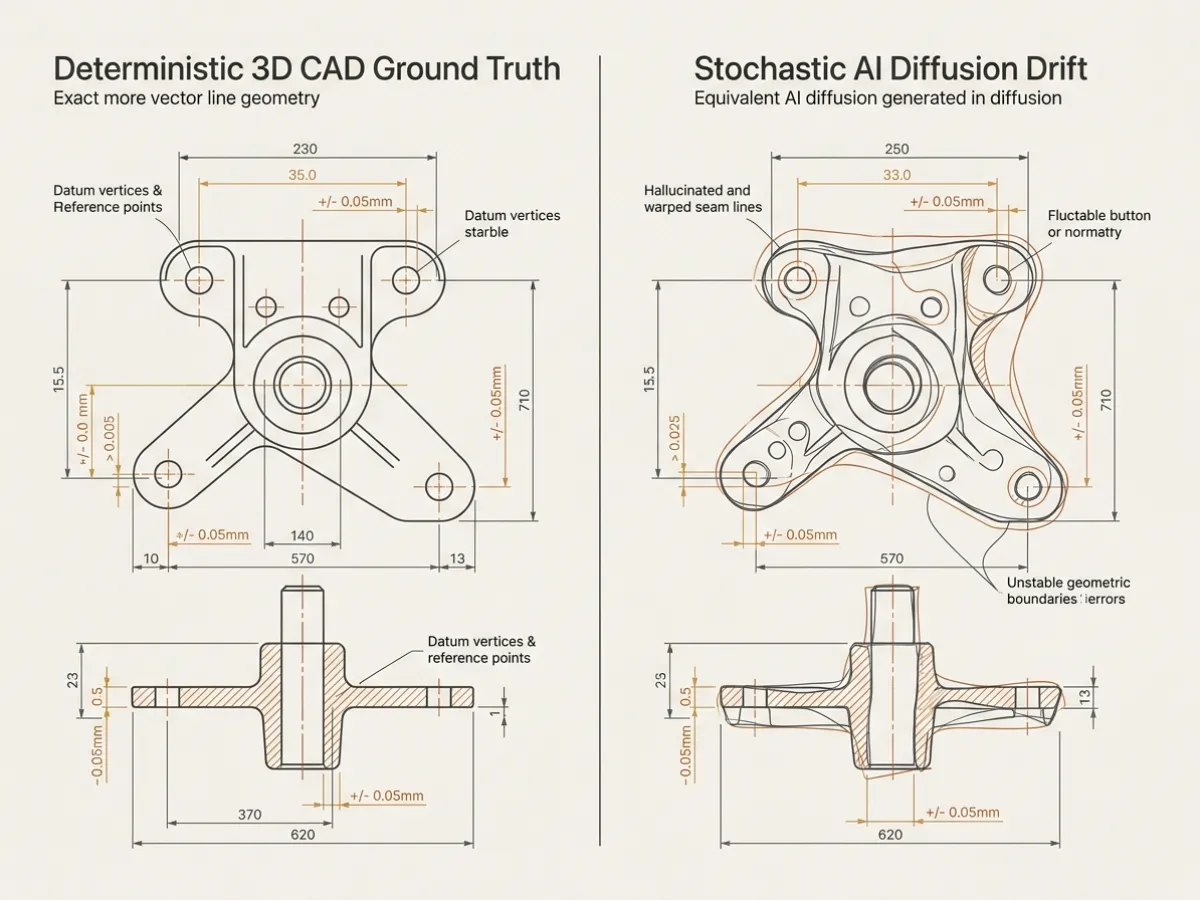
Modern image-generation and editing systems are becoming remarkably good at maintaining a referenced object. But maintaining exact product identity and geometric consistency is still an active area of computer-vision research.
Researchers working on instruction-based image editing specifically describe challenges around product identity preservation. Other work on iterative image editing identifies identity drift and accumulated errors as edits are made over multiple generations.
That matters enormously for product manufacturers.
Imagine an AI image of a cabinet.
At first glance, everything looks correct.
But compare it carefully with the actual SKU: - The legs may have moved slightly. - The handles may be a little longer. - The spacing between the doors may have changed. - The depth may appear different. - A material transition may have disappeared. - The number of slats may have changed.
None of those differences necessarily make the image look bad.
In fact, the image might look fantastic.
The problem is that it may no longer depict the actual product.
That Creates a Customer-Experience Problem
For inspiration imagery, a tiny discrepancy might not matter.
For ecommerce, furniture, architecture, manufacturing, or product specification, it can matter a great deal.
The customer is making a purchasing decision based on what they see.
If the visual representation slowly drifts away from the product they eventually receive, beautiful marketing imagery can create the opposite of what it was intended to create:
a disappointed customer.
This is why we think the conversation shouldn't be framed as:
AI or 3D?
The better question is:
Where should AI be allowed to invent, and where must the product remain fixed?
The Strongest Workflow May Be 3D + AI
This is where things get interesting.
We don't see AI replacing 3D visualization.
We increasingly see the two technologies working together.
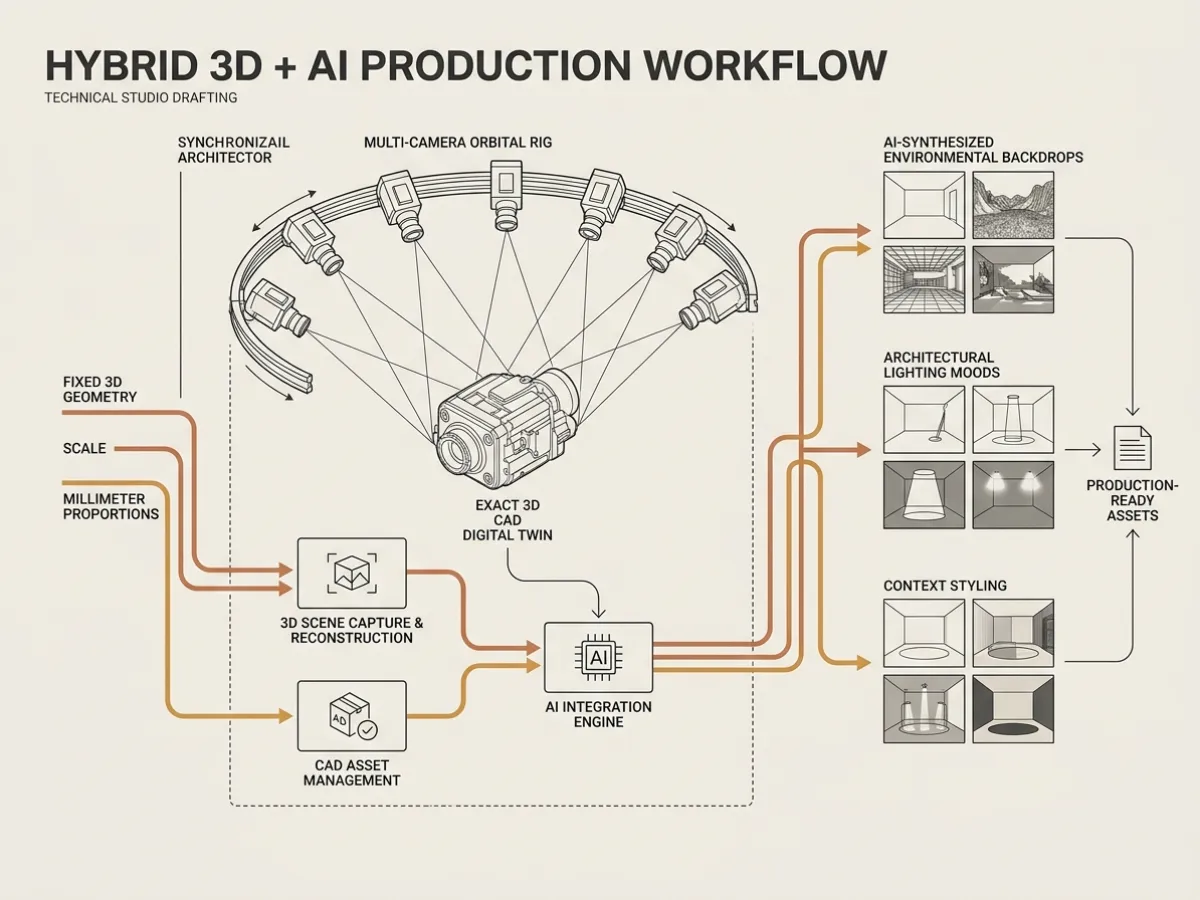
The 3D asset provides the controlled product.
AI provides extraordinary creative flexibility around it.
3D Can Control - Product geometry - Camera position - Scale - Proportions - Materials - Configuration - Component placement - Product accuracy
AI Can Help Explore - Environments - Styling - Decor - Lighting concepts - Seasonality - Campaign concepts - Creative variations - Visual storytelling
That separation is powerful.
You can tell AI:
Be creative with the world around this product.
While telling the product asset:
Don't move.
3D Also Creates Interoperability
There is another reason we still care deeply about creating good 3D assets: reuse.
A marketing photograph is an output.
A 3D model is an asset from which many outputs can be created.
The same well-built product model can potentially move through an increasingly large content ecosystem:
CAD and design workflows
↓
CGI
↓
Ecommerce
↓
Configurators
↓
Animation
↓
Video
↓
AR
↓
Spatial computing
↓
AI-assisted content production
That means the investment isn't simply buying one image.
You're building a reusable digital representation of the product.
And the more channels that representation can serve, the more valuable the original asset becomes.
So, Do You Need 3D?
Here is our answer.
For every image? No.
AI is already extraordinarily useful for ideation, experimentation, backgrounds, campaign exploration, and many forms of content generation.
But if product accuracy matters - and especially if the same product needs to appear repeatedly across multiple pieces of content - a controlled 3D asset remains one of the strongest foundations you can build.
The future isn't necessarily 3D versus AI.
We think it looks much more like:
3D for Truth. AI for Possibility.
And when the two are combined intelligently, brands get something neither approach delivers quite as well alone:
creative freedom without losing control of the product.
Suggested SEO Information
SEO Title:
AI vs. 3D Product Rendering: Do You Still Need a 3D Model?
Suggested URL:
/ai-vs-3d-product-rendering/
Meta Description:
Can AI replace 3D product rendering? Learn why 3D remains valuable for product accuracy, consistency, and reusable digital assets - and where AI fits.
Primary Topic:
AI vs. 3D product rendering
Related Topics: - 3D product visualization - CGI product rendering - AI product imagery - digital product assets - product identity preservation - identity drift - ecommerce product visualization - 3D digital twins
Recommended Original Evidence
To make this article substantially more authoritative, Vux & Hoy should create an original visual comparison using one real product.
The test should include:
- authoritative source photography or product information;
- the controlled Vux & Hoy 3D model;
- accurate CGI generated from that model;
- AI-generated imagery based on product references;
- several iterative AI edits.
Compare the outputs and identify any differences in: - hardware placement; - proportions; - seams; - number of components; - material transitions; - leg geometry; - dimensions; - product configuration.
Annotate those differences visually.
This changes the article from:
Here is our opinion.
to:
Here is what we tested, and here is what happened.
Research References
Google Search Central
AI features and your website
https://developers.google.com/search/docs/fundamentals/ai-optimization-guide
Relevant to the article's SEO/GEO strategy and Google's emphasis on useful, unique, expert-led content.
Product Identity Preservation
ProductConsistency: Improving Product Identity Preservation in Instruction-Based Image Editing via SFT and RL
Computer Vision Foundation / CVPR 2026 Workshop.
Relevant to the challenge of preserving product identity during generative image editing.
Identity Drift
AnchorEdit: Maintaining Temporal Consistency in Multi-turn Image Editing via Causal Memory
https://arxiv.org/abs/2606.11751
Relevant to identity drift and accumulated changes during repeated image-editing operations.
Geometric and Depth Consistency
Zero-Shot Depth Aware Image Editing with Diffusion Models
Computer Vision Foundation / ICCV 2025.
Relevant to spatial, geometric, and depth control in generative image editing.
Core Position
3D for truth. AI for possibility.
The goal is not to argue that brands must choose between AI and 3D.
The opportunity is to understand what each technology does best - and build workflows that combine the creative flexibility of AI with the control, accuracy, and interoperability of structured 3D assets.
Frequently asked questions
Can AI Generate Product Images Without a 3D Model?
Yes. Modern generative AI can create product imagery from photographs and reference images without requiring an existing 3D model. Whether that approach is appropriate depends on how much geometric accuracy, repeatability, and control the project requires.
Why Use 3D Product Rendering Instead of AI Image Generation?
3D rendering provides explicit control over: - geometry; - materials; - camera position; - scale; - product configuration. Generative AI offers greater creative flexibility, but exact identity and geometric consistency remain active technical challenges in image-generation research.
Can AI Change Product Details Accidentally?
Yes. In technical literature, problems such as: - identity drift; - identity preservation; - structural consistency; - geometric consistency; - non-target content preservation; are actively studied in generative image editing. An AI-generated product image can appear realistic while subtly changing a detail that was not intended to change.
What Is Identity Drift in AI Image Generation?
Identity drift describes the gradual alteration of a subject's defining characteristics during generation or repeated editing. In product imagery, that can mean unwanted changes to: - shape; - proportions; - hardware; - construction details; - materials; - geometry. This is one reason product imagery generated with AI should still be checked against an authoritative product reference.
What Is the Best Workflow for AI Product Visualization?
For products where accuracy matters, a strong approach is to use a controlled product asset (often 3D) as the reference or foundation, while using generative AI for: - environments; - styling; - campaign concepts; - visual storytelling; - creative variations. This gives the creative system freedom while helping preserve the product itself.
Will AI Eventually Replace 3D Product Rendering?
AI will almost certainly continue reducing the amount of traditional production work required for many images. At the same time, current research continues to introduce explicit geometry, depth, camera, and identity-preservation mechanisms to improve generative-image control. That suggests structured product information and geometry will continue to have value even as the tools used to create the final image evolve.
See it in practice: Soul Zen relied on controlled 3D geometry rather than unconstrained image generation to prevent product hallucination across launch channels. Read the case study
Tell us what you are working on.
Send an idea, a drawing, a sample or a whole assortment. We will identify what is missing and the right next step.
Start a conversation