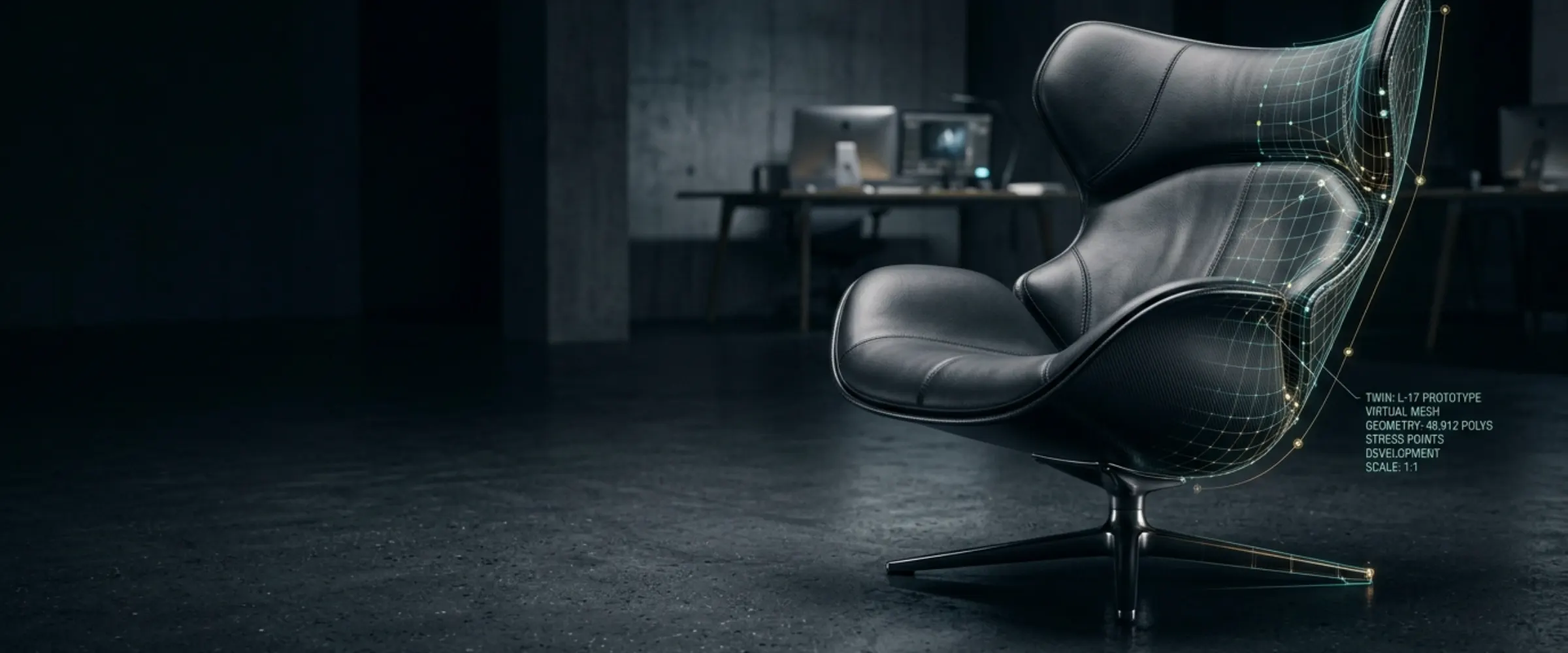
The Future of Commerce
The Future of Product Development: The Rise of the Virtual Product
A virtual product is the complete body of digital knowledge associated with a physical product. Learn how connected product data turns design into a continuous learning loop.
A product has always meant something physical: a chair, a sofa, a table, a lamp.
Something designed, engineered, manufactured, shipped, sold and ultimately used by a person in the real world.
We gradually created more digital information around those products. CAD files. Technical drawings. 3D models. Product photography. CGI. Specifications. Assembly instructions. E-commerce data.
But we continued to think of those things primarily as files belonging to the physical product.
AI is about to change that relationship.
We are moving toward something we call the virtual product.
And we believe it could fundamentally change how we develop physical products.
What is a virtual product?
A virtual product is not simply a 3D model.
It isn't a CAD file.
And while there is some overlap with the increasingly popular term "digital twin," that is not quite what we mean either.
A virtual product is the complete body of digital knowledge associated with a physical product.
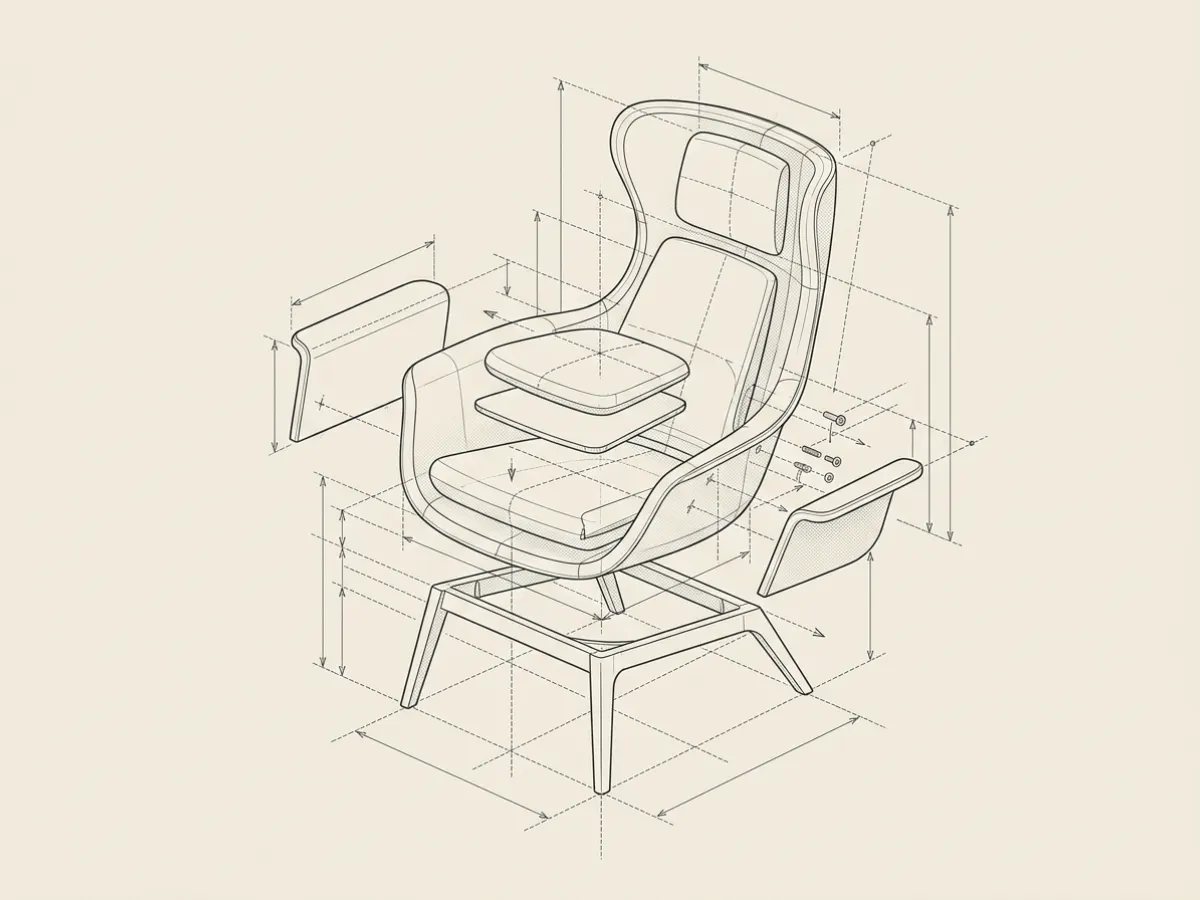
That could include: - the original design brief - research and trend information - sketches and concepts - CAD and engineering data - dimensions and specifications - materials and finishes - BOM and component information - manufacturing constraints - supplier information - prototypes and revisions - packaging - assembly instructions - photography and CGI - marketing content - merchandising information - pricing - sales performance - customer reviews - returns - warranty claims - customer service data
And eventually, potentially much more.
The physical product exists in physical space.
The virtual product exists in data.
The interesting part is what happens when AI can understand the relationships between all of it.
We've been building virtual products for years without calling them that
The concept itself isn't entirely new.
Product development has been becoming more digital for decades.
Hand drawings became CAD.
Physical prototypes were supplemented by 3D visualization.
Photography was supplemented, and sometimes replaced, by CGI.
Paper specifications moved into PLM, ERP and PIM systems.
Retailers accumulated enormous amounts of product information across their organizations.
But those systems generally solved individual problems.
Engineering had its information.
Manufacturing had another set.
Marketing created another.
E-commerce created another.
Customer service generated another.
Then customers themselves created an entirely new dataset through reviews, returns, questions and purchasing behavior.
We have spent decades digitizing the product lifecycle.
What we haven't necessarily done is treat all of that information as one product.
AI gives us a reason to start.
The virtual product starts before the physical product exists
This is where the idea becomes particularly powerful for product development.
A virtual product doesn't have to begin when the final CAD file is completed.
It can begin with the brief.
Imagine developing a new dining chair.
Before anyone sketches it, there may already be information about:
the target customer, intended retail price, competitive products, previous sales, manufacturing capabilities, packaging limitations, material costs, customer reviews and gaps in the existing assortment.
That information already describes the product we should be trying to create.
The design process adds another layer.
Sketches.
Decisions.
Rejected concepts.
Engineering.
Costing.
Prototypes.
Testing.
Every decision creates more information.
Eventually, a physical chair emerges from that process.
But the virtual product has been developing alongside it the entire time.
Then the customer teaches us what we got right
Traditionally, we tend to think of product development as ending somewhere around production.
The factory starts manufacturing the product.
Marketing launches it.
Customers buy it.
Then the product development team moves on to the next thing.
But from a data perspective, that's exactly when something incredibly valuable begins.
Reality gives us the answer.
Did people buy it?
At what price?
Which color sold?
Which imagery converted?
What did customers love?
What did they complain about?
Why did they return it?
Did they struggle to assemble it?
Did one component fail?
Did it outperform the products around it?
Did customers use it in a way we hadn't anticipated?
All of that information can flow back into the virtual product.
And suddenly the product isn't simply a record of what we designed.
It becomes a record of what we learned.
The physical product is the test
This distinction matters.
The objective is not to build increasingly sophisticated digital products for their own sake.
Commercial product design ultimately has to prove itself in the real world.
You can have a beautiful concept.
You can have perfect CAD.
You can create spectacular CGI.
You can have an incredibly sophisticated AI model.
But if customers don't want the physical product, something went wrong.
The physical world is where the hypothesis gets tested.
Did we design the right thing?
Did we make it at the right cost?
Did we communicate its value?
Did customers choose it?
Did they keep it?
Did they recommend it?
The virtual product gives us more information with which to make those decisions.
The physical product gives us the evidence of whether those decisions were correct.
And then that evidence goes back into the system.
Product development becomes a learning loop
This is where the model changes.
Instead of:
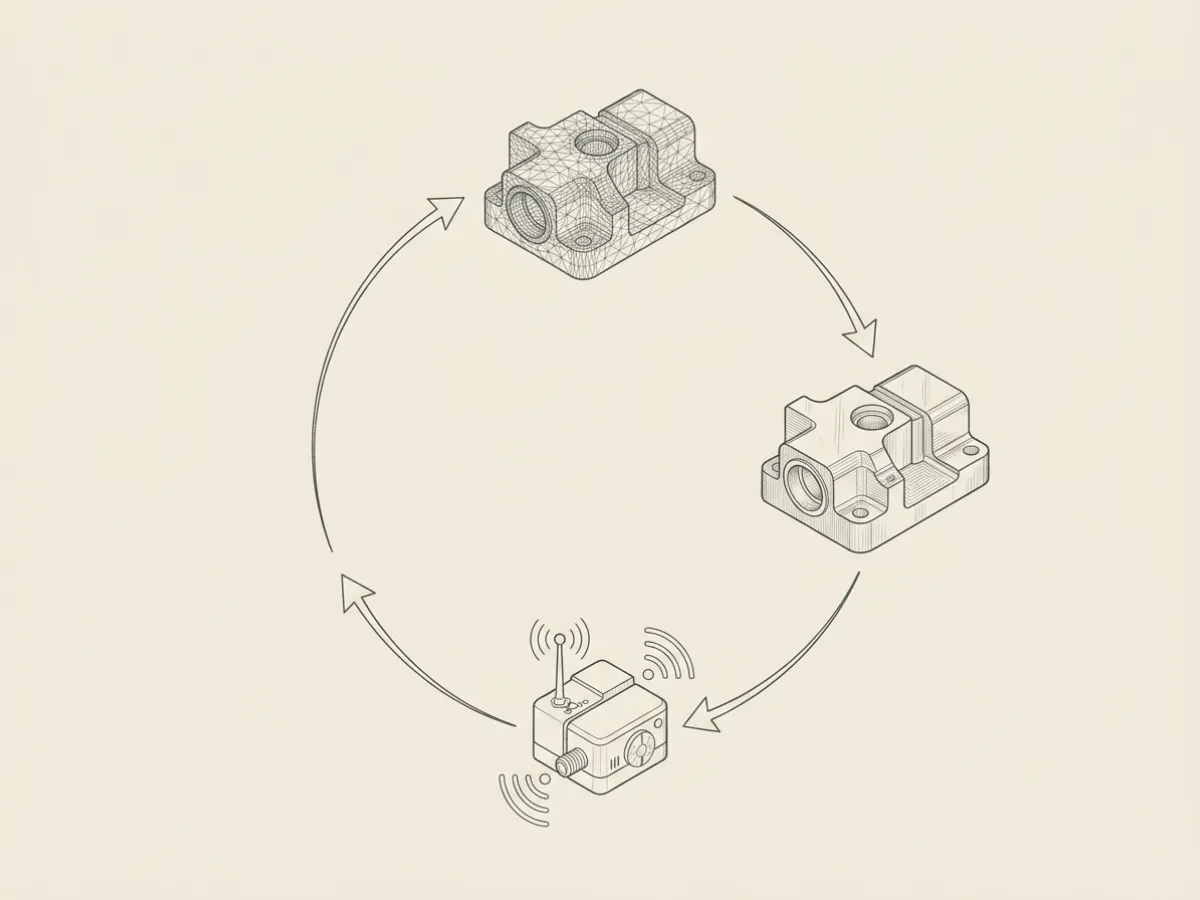
Design → Manufacture → Sell → Next Product
we move toward:
Learn → Design → Manufacture → Sell → Measure → Learn
The difference looks small.
It isn't.
Because the knowledge from one product doesn't have to disappear when the next development cycle begins.
Imagine an organization that has developed 10,000 products.
Those products collectively contain an extraordinary amount of knowledge.
Which proportions sell.
Which materials return.
Which price points convert.
Which construction methods fail.
Which colors perform by market.
Which assembly steps generate support calls.
Which packaging configurations cause damage.
Which visual styles generate clicks.
Which combinations of attributes repeatedly produce successful products.
Humans already learn some of this intuitively.
The problem is that much of that knowledge lives inside people's heads.
AI gives us another possibility.
Can we capture the "magic" of a great product designer?
Consider what makes some designers consistently produce commercially successful products.
From the outside, it can look like intuition.
A good product designer walks through a factory and notices something other people don't.
They understand what a machine can do.
They recognize an underused material.
They know where adding five dollars creates twenty dollars of perceived value and where adding five dollars achieves nothing.
They understand the customer, price, packaging, manufacturing, proportion, trend and timing simultaneously.
Eventually they look at a design and say:
That's the one.
It can feel like magic.
But a large part of that "magic" is pattern recognition built from experience.
A designer who has developed hundreds or thousands of products has accumulated an enormous internal dataset.
They have seen what worked.
They have seen what failed.
They have visited factories.
They have handled samples.
They have read customer reactions.
They have watched trends arrive and disappear.
Their intuition has an empirical foundation, even if they can't always articulate every variable behind a decision.
What happens when AI can learn those patterns too?
This is where AI becomes much more interesting than image generation.
Imagine giving an AI access not simply to the final products a company created, but to the history surrounding them.
The briefs.
The concepts.
The materials.
The factories.
The costs.
The constraints.
The revisions.
The imagery.
The sales.
The reviews.
The returns.
The failures.
The successes.
Now ask it to look for patterns.
Perhaps products with a certain combination of attributes consistently outperform their category.
Perhaps one material performs beautifully in imagery but produces disproportionately high returns.
Perhaps a particular price jump dramatically changes conversion.
Perhaps customers repeatedly praise a detail nobody inside the company realized was important.
Perhaps products developed with one manufacturing constraint actually perform better than products developed with greater creative freedom.
Those aren't creative prompts.
They're evidence.
And evidence begins to give design intuition an empirical counterpart.
Predictive product development
Eventually, this leads to a much more interesting question than:
"Can AI design a chair?"
Of course AI can generate a picture of a chair.
It can generate thousands of them.
That's not the hard part.
The hard question is:
Which chair should we make?
Which product has the greatest probability of succeeding for this customer, at this price, through this factory, using these materials, within these constraints, in this market, right now?
That is a fundamentally different problem.
And it's where the accumulated knowledge inside the virtual product becomes extraordinarily valuable.
AI could help product teams evaluate concepts against historical performance.
It could identify gaps in assortments.
It could recognize patterns across customer feedback.
It could surface manufacturing opportunities.
It could predict potential return reasons before production.
It could connect design decisions to commercial outcomes.
Not perfectly.
Prediction is not certainty.
Customers will continue to surprise us. Culture changes. Trends shift. Truly innovative products often succeed precisely because they don't resemble what came before.
But designers wouldn't be starting with a blank page either.
They would be designing with access to an extraordinary body of accumulated evidence.
This doesn't remove the designer
The role of the designer becomes more interesting, not less.
AI can process more information than any individual person reasonably can.
But product development isn't simply an optimization problem.
Someone still has to decide what should exist.
Someone has to interpret culture.
Someone has to understand aspiration.
Someone has to challenge what the historical data says.
Someone has to recognize when the constraint should be accepted and when it should be broken.
Someone has to imagine something customers don't yet know how to ask for.
The designer's role shifts from being the person who creates every answer to the person who asks better questions, interprets evidence and makes better decisions.
The magic doesn't disappear.
We give the magic more evidence.
The virtual product never really stops developing
And perhaps this is the biggest change.
A physical product eventually becomes fixed.
The tooling is made.
Production begins.
The chair exists.
Its dimensions aren't going to change because somebody left a review.
But its virtual counterpart can continue learning.
Every sale adds information.
Every return adds information.
Every review adds information.
Every support question adds information.
That information may not change the chair already sitting in someone's dining room.
But it can change the next production run.
The next color.
The next collection.
The next chair.
The next brief.
The virtual product therefore becomes more than a digital representation of an object.
It becomes part of the organization's product memory.
The future of product development isn't AI-generated products
The most important change coming to product development is not that AI will suddenly design everything for us.
That's actually a fairly narrow view of what's happening.
The bigger opportunity is connecting everything we already know.
Design knowledge.
Manufacturing knowledge.
Commercial knowledge.
Customer knowledge.
And the real-world performance of the products we've already made.
The companies that do this well will gradually build something incredibly difficult to replicate:
a proprietary intelligence about what they should make next.
Their competitive advantage won't simply be access to the newest AI model. Everyone will eventually have access to powerful models.
The advantage will be what those models know about their products, their customers and their history.
That is why we believe the virtual product matters.
The physical product is still the point.
It still has to be manufactured.
It still has to work.
Someone still has to want it.
Someone still has to buy it.
But surrounding that physical object will be an increasingly rich, intelligent and evolving body of knowledge.
And every product we make will teach us how to make the next one better.
Frequently asked questions
What is a virtual product?
A virtual product is the complete body of digital knowledge associated with a physical product. It connects design briefs, CAD files, material specifications, manufacturing constraints, CGI assets, sales performance, customer reviews, returns data, and warranty records into a single evolving product intelligence.
How is a virtual product different from a digital twin?
While a digital twin primarily focuses on 3D geometry and operational specifications, a virtual product encompasses the entire lifecycle dataset, including upstream design briefs, commercial sales data, customer feedback, returns, and organizational product learning.
What is predictive product development?
Predictive product development uses accumulated historical product data and AI pattern recognition to evaluate new concepts against past commercial outcomes, helping teams identify which product attributes have the highest probability of market success.
When does a virtual product begin in the development process?
A virtual product begins with the initial design brief, long before physical manufacturing starts. It captures target pricing, competitive benchmarks, customer requirements, material constraints, and design decisions as they are resolved.
How does customer feedback feed back into the virtual product?
After launch, real-world customer reviews, return reasons, warranty claims, and assembly issues flow directly into the virtual product record, turning the digital model into an empirical learning archive that informs future production runs and designs.
How does the virtual product change the product development cycle?
It transforms a linear sequence (Design to Manufacture to Sell) into a continuous learning loop (Learn, Design, Manufacture, Sell, Measure, Learn), preserving institutional knowledge across thousands of products rather than losing it between cycles.
Tell us what you are working on.
Send an idea, a drawing, a sample or a whole assortment. We will identify what is missing and the right next step.
Start a conversation