
Digital Products & Product Data
How Many Product Images Does an AI Agent Actually Need? It's Not a Fixed 10–15
Discover the real image requirements for AI shopping agents. Learn why spatial coverage, functional evidence, and structural clarity matter more than raw image count.
Ask how many images an ecommerce product page should have and you'll find plenty of answers.
Six.
Eight.
Ten.
Fifteen.
For furniture and home goods, some current ecommerce guidance recommends 10–15 product images, including hero imagery, additional angles, details, lifestyle scenes, scale references, and packaging.
The reasoning is usually based on the human shopper:
More views reduce uncertainty.
That's sensible.
A customer can't pick up the chair.
They can't walk around the sofa.
They can't open the cabinet door.
So we compensate with more pictures.
But AI shopping agents introduce a different question.
Not:
How many pictures make a shopper feel sufficiently confident?
But:
Does this set of images provide complete, non-redundant, checkable evidence about the product?
Those are not quite the same problem.
And once you frame the question that way, image count becomes a surprisingly weak metric.
Ten Images Can Still Tell You Almost Nothing
Imagine a product page for a chair.
It contains ten images.
Image 1
Front three-quarter lifestyle view.
Image 2
Slightly wider crop of the same view.
Image 3
Same room, camera moved slightly left.
Image 4
Close-up of the seat fabric.
Image 5
Another lifestyle image from approximately the same angle.
Image 6
Styled room image.
Image 7
Detail of a cushion.
Image 8
Another fabric detail.
Image 9
Chair in a different room.
Image 10
Promotional crop.
Technically:
10 images.
But can we answer: - What does the rear look like? - What is the side profile? - How are the back legs constructed? - Is the rear fully upholstered? - What does the underside look like? - Where exactly are the arms connected? - Is the configuration consistent across every image?
Maybe not.
The gallery contains plenty of visual content.
But it may contain very little additional product information after the first few images.
Now Imagine a Three-Image Set
Image 1 - Front Three-Quarter
Establishes: - overall form; - seat; - arms; - front legs; - upholstery; - general proportion.
Image 2 - Rear Three-Quarter
Establishes: - rear construction; - back upholstery; - rear legs; - frame relationships.
Image 3 - Side / Detail
Establishes: - depth; - side profile; - seat-to-back relationship; - arm construction; - important material detail.
Could those three images communicate more unique product information than the ten-image gallery?
Potentially, yes.
That does not mean three is the correct number for every product.
It means:
Coverage matters more than count.
An Ecommerce Image Gallery Is a Set, Not a Stack of Independent Pictures
This distinction has already appeared in serious ecommerce research.
In 2022, researchers at JD.com published Automatic Generation of Product-Image Sequence in E-commerce at the ACM SIGKDD Conference on Knowledge Discovery and Data Mining.
Their problem was enormous.
JD.com's platform contained product listings with large numbers of candidate images, while a premium discovery channel required concise, high-quality image presentations.
Manually choosing and organizing those images at scale was expensive.
So the researchers built a system to automatically select and evaluate product-image sequences.
That word matters:
Sequence.
They were not simply asking:
Is this a good photograph?
They were evaluating how images work together.
They Divided Image Rules Into Three Levels
The JD.com researchers describe three broad categories of ecommerce image rules.
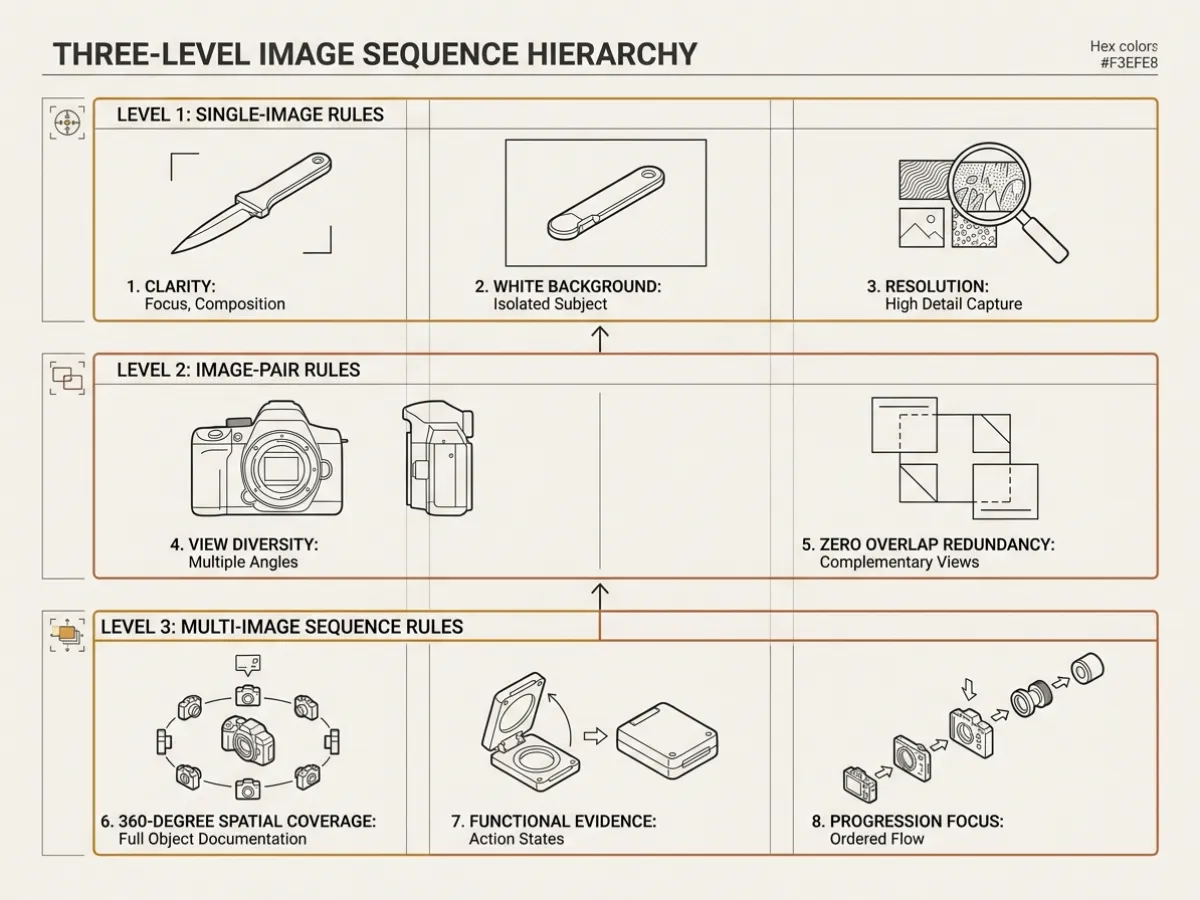
1. Single-Image Rules
These evaluate one image independently.
Examples include: - image quality; - blur; - unnatural artifacts; - logos; - banners; - watermarks; - non-compliant content.
The question is:
Is this individual image acceptable?
2. Image-Pair Rules
These compare one image with another.
One example given in the paper is that two images should not show the product from excessively similar viewing angles.
The question becomes:
Does this image add something the previous image didn't already show?
The system also included image-duplication detection.
3. Multi-Image Rules
These evaluate the complete sequence.
The purpose is to determine whether the collection of images provides adequate product information and presents it in an appropriate order.
That changes the question again:
Does this gallery work as a complete representation of the product?
That Is a Much More Interesting Way to Think About Ecommerce Imagery
Instead of asking:
Do we have ten images?
ask three questions.
Is every individual image useful?
Does each new image contribute information that the others don't?
Does the complete set adequately represent the product?
Now we're measuring information architecture, not simply image quantity.
JD.com Was Doing This at Production Scale
This wasn't just a conceptual research exercise.
The authors report that their Automatic Generation of Product-Image Sequence framework was deployed in JD.com's recommendation platform beginning in February 2021.
By December 2021, it had generated high-standard image sequences for approximately 1.5 million products.
In the dataset described in the paper, a product had approximately seven candidate images on average, while the target sequence used in that implementation contained three images. The authors explicitly note that the framework can work with different sequence sizes.
This is important.
It would be incorrect to conclude:
JD.com proved three images are optimal.
They did not.
What they demonstrated is something much more useful:
The quality of an ecommerce gallery can be evaluated according to relationships between images - not merely according to the number of images present.
The Agentic-Commerce Version of This Problem
Now imagine a shopping agent examining the same image sequence.
A customer asks:
Find me a dining chair with upholstered front and back surfaces, exposed wooden legs, and arms low enough to fit beneath my table.
The agent may need visual evidence for: - front upholstery; - rear upholstery; - leg material; - arm construction; - overall product configuration.
If all 12 images show the chair from roughly the same front angle, the gallery has a coverage gap.
Adding image number 13 from the same angle doesn't solve it.
The problem isn't quantity.
It's missing information.
Every Image Should Have a Job
This leads to a better way of planning ecommerce imagery.
Rather than deciding:
We need ten images.
define the questions the image set needs to answer.
For a chair, these might include:
Identity
What exactly is the product?
Overall Form
What is its complete shape and proportion?
Front Construction
What can be seen from the front?
Rear Construction
What can be seen from the rear?
Side Profile
How deep is it and how are components related?
Materials
What do the important surfaces look like?
Details
Which construction or design features matter?
Scale
How large does the product appear in context?
Use
How is it intended to function?
Now the images are filling information roles.
The Correct Number Becomes an Output, Not an Input
Once those roles are defined, the number of images emerges naturally.
A simple stool might require:
3 or 4 images.
A sectional sofa may require:
8 or 12.
A configurable wardrobe system might require considerably more.
A simple pendant light may need fewer.
The point isn't that AI agents need fewer images than people.
They may sometimes need more.
The point is:
There is no reason to assume every product in a category needs the same arbitrary count.
Completeness Is the First Requirement
A useful image set should provide adequate coverage of the product.
For furniture, that might mean answering: - What does the front look like? - What does the rear look like? - What does the side look like? - Which surfaces use which material? - What are the important construction details? - What is included? - What changes between configurations?
If a commercially important characteristic isn't visible anywhere, the image set contains an information gap.
Non-Redundancy Is the Second Requirement
Now look for the opposite problem.
Imagine six photographs showing: - front-left 30°; - front-left 32°; - front-left 35°; - front-left 40°; - front-left lifestyle; - front-left close crop.
They're technically different photographs.
Informationally, they may be nearly identical.
The JD.com system explicitly addressed this problem through image-pair comparison and duplication detection. The researchers describe a rule intended to prevent two images from presenting the product from similar viewing angles.
That's a powerful principle:
A new image should earn its place.
Ordering Is the Third Requirement
Image sequence matters too.
For humans, the first image performs a different role from image eight.
The JD.com system explicitly selected a primary image before constructing the rest of the sequence.
For an ecommerce gallery, a sensible sequence might progress from:
identity
↓
overall form
↓
complementary angle
↓
hidden surfaces
↓
details
↓
materials
↓
context
rather than presenting images in an arbitrary order.
The optimal sequence will vary by product and channel.
But sequence itself is part of the design problem.
Human Confidence and Machine Coverage Are Different Objectives
This is where traditional ecommerce advice and agent-ready imagery begin to separate.
For a human, multiple similar lifestyle images may still have value.
They can build: - desire; - mood; - confidence; - brand positioning; - emotional context.
Those are legitimate reasons to include them.
An agent may evaluate the same images differently.
Once a product characteristic has been established clearly, another near-identical view may provide little additional evidence.
So the future ecommerce gallery may need to optimize for two audiences simultaneously.
The Human Needs Confidence
A person may want: - beautiful hero imagery; - lifestyle scenes; - scale references; - styling inspiration; - emotional reassurance; - material close-ups.
The question is:
Can I imagine owning this?
The Agent Needs Coverage
A machine may need: - identifiable product; - complementary viewpoints; - visible components; - distinguishable materials; - configuration consistency; - unambiguous product relationships.
The question is:
Do I have sufficient evidence to answer the customer's question?
The Best Gallery Has to Do Both
This doesn't mean creating two entirely separate image libraries.
It means understanding which images serve:
human persuasion
and which serve:
product verification.
Some images can do both.
A clean three-quarter hero image may: - look beautiful to the shopper; - establish significant product geometry for the agent.
A rear view may be less emotionally persuasive but extremely valuable for product verification.
A lifestyle image may establish context and scale but obscure construction details.
Each image plays a role.
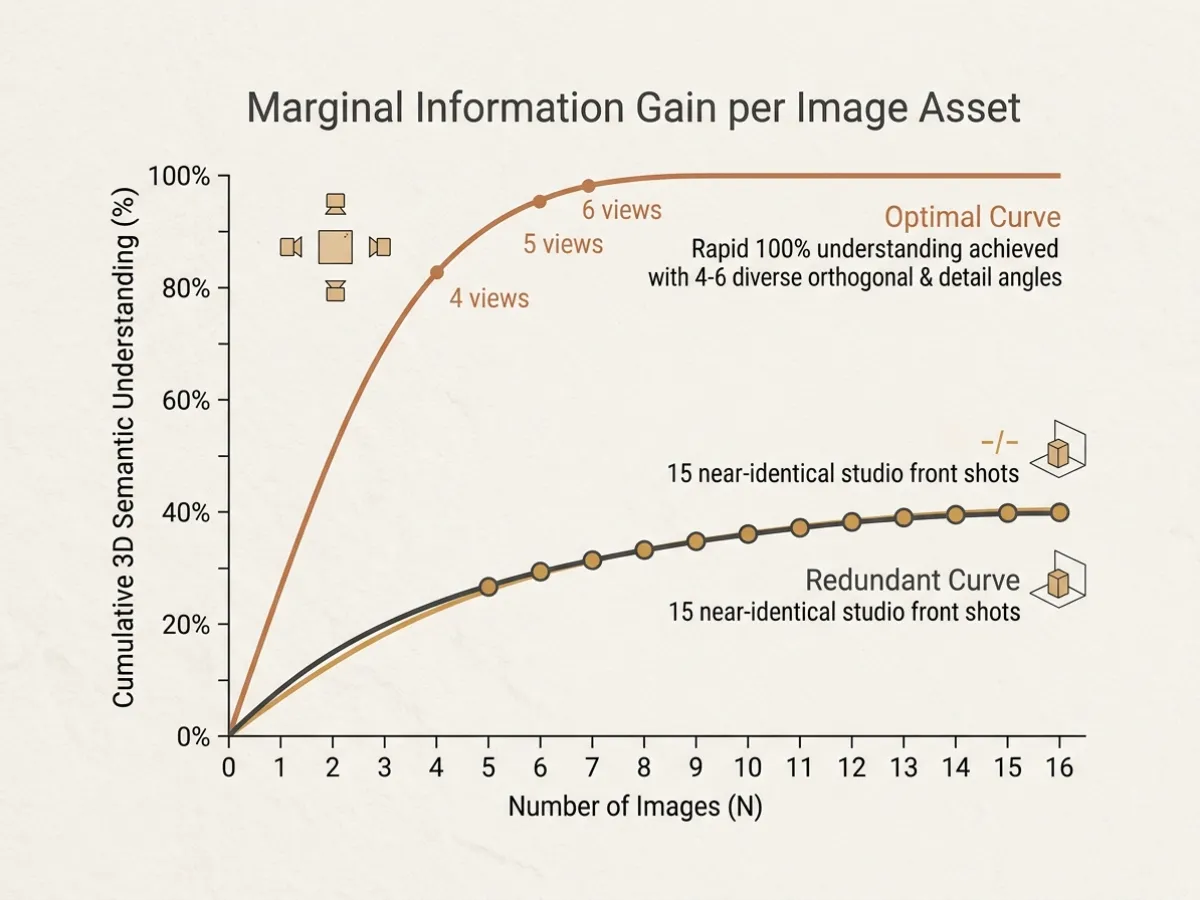
This Suggests a New Metric: Information Gain
Imagine evaluating every new image with one question:
What can we establish from this image that we couldn't establish confidently from the images before it?
If the answer is:
Nothing.
the image may be redundant.
If the answer is:
It shows the rear construction.
good.
It establishes upholstery continuity.
good.
It shows the material texture.
good.
It establishes scale.
good.
The goal becomes maximizing unique useful information per image.
Think in Terms of a Coverage Matrix
For a chair, the system might look like this:
| Product Fact | Hero | Front | Rear | Side | Detail | Lifestyle |
|---|---|---|---|---|---|---|
| Overall form | ✓ | ✓ | ✓ | ✓ | ✓ | |
| Front construction | ✓ | ✓ | ||||
| Rear construction | ✓ | |||||
| Side profile | ✓ | ✓ | ||||
| Leg design | ✓ | ✓ | ✓ | ✓ | ✓ | |
| Upholstery texture | ✓ | |||||
| Scale/context | ✓ |
Now gaps become visible.
And so does duplication.
If four images all cover exactly the same columns, ask why all four exist.
Different Categories Need Different Coverage
This is why a universal image-count rule is unlikely to be ideal.
Dining Chair
Important coverage might include: - front; - rear; - side; - upholstery; - frame; - scale.
Sofa
Add: - full seating configuration; - rear; - arms; - cushion construction; - upholstery detail; - leg/base; - room scale; - modular connections where applicable.
Cabinet
Important coverage might include: - closed front; - open interior; - rear; - side; - hardware; - storage layout; - material detail.
Dining Table
Important coverage might include: - top; - base; - edge profile; - underside; - extension mechanism; - seating context; - material detail.
The product determines the evidence required.
Configurable Products Make Count Even Less Useful
Imagine a sofa available in: - three widths; - two arm styles; - four modules; - twelve fabrics; - three leg finishes.
How many images does the product need?
Ten?
Fifteen?
Fifty?
The question quickly becomes meaningless.
What matters is whether the asset system explains: - what remains constant; - what changes; - which configurations exist; - what each option looks like; - which images represent which configuration.
This is an information architecture problem, not a photography quota.
Image Consistency Matters Across the Sequence
There is another issue that becomes especially important with AI-generated imagery.
Imagine a ten-image gallery where:
Image 1 has five back slats.
Image 2 has six.
Image 3 subtly changes the leg position.
Image 4 changes the hardware.
Every image is beautiful.
But the sequence contradicts itself.
For a human, some differences may go unnoticed.
For an automated system trying to establish product truth, contradictory evidence creates a different problem:
Which image should be trusted?
So image-set quality also requires:
consistency across views.
The Sequence Should Describe One Product
This seems obvious.
But generative workflows make it newly important.
A product-image sequence should preserve: - geometry; - proportions; - components; - materials; - hardware; - configuration; - identity.
The camera can change.
The environment can change.
The lighting can change.
The product should not.
There Is Another Important Lesson in the JD.com Research
The model did not evaluate imagery in isolation.
The researchers also supplied textual product descriptions as additional semantic information when evaluating the image sequence.
That reinforces an important principle from the rest of this series:
The strongest ecommerce representation is multimodal.
Images should not be expected to communicate every fact.
Text should not be expected to replace visual evidence.
Structured product information should not eliminate imagery.
They work together.
So How Many Images Does an AI Agent Need?
The scientifically responsible answer today is:
We don't know a universal number.
There is not yet sufficient published research testing autonomous shopping agents across product categories to say:
A furniture agent requires exactly X images.
And the JD.com paper should not be interpreted that way.
But it gives us a much better framework for asking the question.
Instead of:
How many images?
ask:
Are the individual images compliant and useful?
Are any images unnecessarily redundant?
Does the sequence adequately cover the product?
Is the product consistent across the sequence?
Does every important visual attribute have evidence?
Is the sequence organized intentionally?
That is a more rigorous standard than simply counting JPEGs.
A Better Question for Brands
Don't ask:
Do we have 10–15 images?
Ask:
Can we remove any image without losing useful information?
Then ask:
Is there anything important about the product that no remaining image establishes?
If the answer to the first question is no,
and the answer to the second is also no,
you may be getting close to an efficient image set.
Enough Images. No Redundancy.
That's the principle.
Not:
more images are always better.
Not:
fewer images are always better.
But:
enough images to establish the product completely,
without unnecessary repetition.
Why This Matters for CGI
A structured CGI workflow is unusually well suited to this problem.
Once the product exists as an accurate digital asset, Vux & Hoy can generate intentional viewpoints according to a category-specific coverage system.
For example:
Chair Asset
↓
Hero
↓
Front
↓
Rear
↓
Side
↓
Material Detail
↓
Scale / Lifestyle
The sequence is designed before the images are produced.
This is very different from accumulating whatever photographs happen to exist.
It Also Makes Large Catalogues More Systematic
Imagine 10,000 furniture products.
Instead of deciding manually that each SKU needs "about ten images," establish coverage standards by category.
For every dining chair: - required product-truth views; - required material evidence; - required context; - optional marketing imagery.
For every cabinet:
a different sequence.
For every sofa:
another.
Now the catalogue becomes auditable.
The system can potentially flag:
Missing rear view.
Duplicate viewing angle.
No material close-up.
Product configuration inconsistent across images.
No scale/context image.
That is a fundamentally different approach to asset management.
And Those Rules Can Be Machine-Checked
This is perhaps the most interesting part of the JD.com precedent.
The researchers weren't merely documenting image guidelines in a brand manual.
They trained systems to determine whether image sequences violated them.
At production scale.
The framework included: - primary-image selection; - non-compliant image detection; - image-pair comparison; - duplication detection; - full-sequence qualification.
That suggests a future where the image-generation pipeline doesn't simply produce assets.
It also checks them.
Suggested SEO Information
SEO Title: How Many Product Images Does an AI Shopping Agent Actually Need?
Alternative SEO Title: How Many Product Images Do You Really Need for Agentic Commerce?
Suggested URL:
/how-many-product-images-ai-shopping-agent/
Meta Description: Forget arbitrary image counts. Learn why AI-ready ecommerce galleries should be designed for complete product coverage, minimal redundancy, consistency, and checkable visual evidence.
Primary Topic: how many product images for AI shopping agents
Related Topics: - product images agentic commerce - AI-ready product photography - ecommerce image sequence - product image coverage - ecommerce CGI - AI shopping product images - product image standards - machine-readable ecommerce imagery - furniture product photography - ecommerce product-image optimization
Research Basis
Automatic Generation of Product-Image Sequence in E-commerce
Xiaochuan Fan, Chi Zhang, Yong Yang, Yue Shang, Xueying Zhang, Zhen He, Yun Xiao, Bo Long, Lingfei Wu
Proceedings of the 28th ACM SIGKDD Conference on Knowledge Discovery and Data Mining, 2022
DOI: 10.1145/3534678.3539149
The JD.com research introduces an automated framework for selecting and evaluating ecommerce image sequences.
Its product-image rules are divided into:
- single-image rules;
- image-pair rules;
- multi-image / sequence rules.
The production framework also includes primary-image selection, non-compliant-content detection, and image deduplication.
By December 2021, the authors report approximately 1.5 million products had received generated high-standard image sequences through the deployed system.
Core Position
The right question isn't "How many product images do we have?"
It is:
Have we shown everything that matters without showing the same thing over and over again?
For human shoppers, imagery reduces uncertainty.
For machines, imagery can provide evidence.
The strongest product-image system should do both.
Complete coverage.
No unnecessary redundancy.
One consistent product.
As many images as the job actually requires.
Frequently asked questions
How Many Product Images Should a Furniture Product Have?
There is no universal number. The appropriate number depends on product complexity, customer needs, sales channel, configuration, and what information each image contributes. Traditional ecommerce guidance often recommends larger image sets for furniture because additional imagery reduces shopper uncertainty. For an agent-ready catalogue, we would also evaluate completeness, redundancy, consistency, and product coverage.
Do AI Shopping Agents Need Fewer Images Than Humans?
We do not yet have sufficient research to say that. An AI agent may sometimes extract substantial information from a small number of well-designed images. For other products, it may require more visual evidence. The important principle is not minimizing image count. It is minimizing **information gaps and unnecessary redundancy**.
Did JD.com Prove Three Images Are Enough?
No. In the dataset described in JD.com's KDD 2022 paper, products had approximately seven candidate images on average and the target sequence in that implementation contained three images. The authors explicitly state that their framework can operate with different sequence sizes. The paper demonstrates automatic selection and evaluation of product-image sequences: not a universal three-image standard.
What Makes a Product Image Redundant?
An image is potentially redundant when it contributes little or no useful product information beyond what another image already establishes. Examples might include two nearly identical viewing angles or repeated crops that reveal no additional product detail. Whether an image is commercially redundant can also depend on its marketing purpose.
What Is Product-Image Coverage?
Product-image coverage describes whether the complete image set adequately represents the important visible characteristics of a product. Depending on the category, this might include: - front; - rear; - side; - materials; - components; - construction; - scale; - details; - configuration.
Should Every Product Have the Same Image Sequence?
Probably not. Different product categories expose different information requirements. A chair, sofa, cabinet, dining table, and lighting fixture should not automatically inherit the same image template. The more useful approach is to develop category-specific coverage standards.
Does a Lifestyle Image Count as Product-Truth Imagery?
It can provide product evidence, but its primary strength is usually context. A lifestyle image may establish: - scale; - intended use; - styling; - spatial relationship. It may be less effective at establishing hidden construction, exact component relationships, or certain material details.
Should Product Images Be Ordered?
Yes. Image order affects how humans experience a gallery, and sequence-level ecommerce research demonstrates that image ordering can itself be treated as part of the qualification problem. A useful sequence generally establishes identity and overall form before moving into complementary views, details, and context.
Tell us what you are working on.
Send an idea, a drawing, a sample or a whole assortment. We will identify what is missing and the right next step.
Start a conversation