AI Product Creation
Why Generic Product Photography Can Be a Hallucination Risk for AI Shopping Agents
Inconsistent studio shots lead AI shopping agents to hallucinate dimensions, materials, and features. Learn how deterministic visual standards protect brand trust.
Hallucination has a specific meaning in AI research.
It refers to the production of plausible but incorrect information - statements that sound right but do not reflect facts.
In language models, hallucination is a widely discussed failure mode.
In multimodal systems that process both images and text, it has a visual dimension as well.
And in ecommerce, it has a commercial dimension that is worth taking seriously.
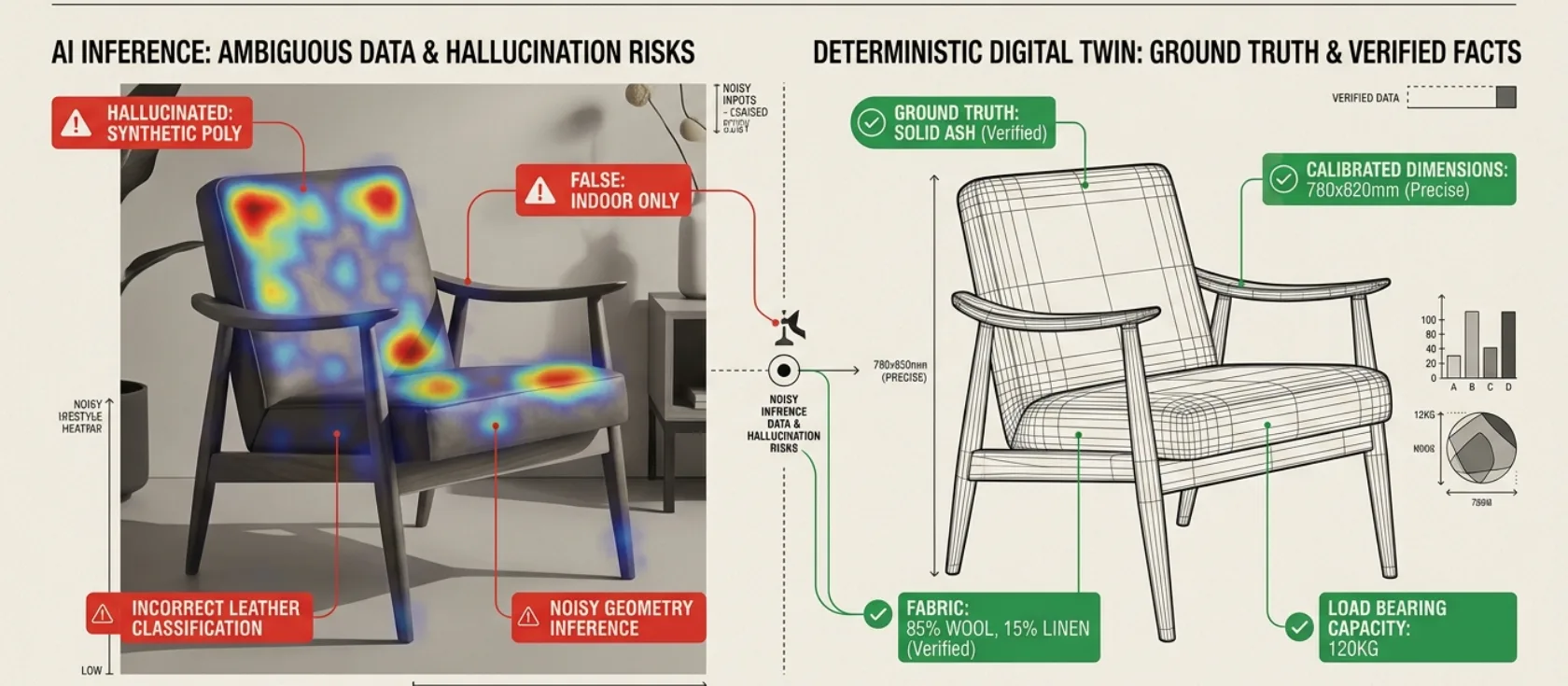
What Can Cause Visual Hallucination in Product Imagery?
When a vision-language model encounters a product image, it doesn't simply read facts from pixels.
It interprets visual evidence.
It draws on patterns from training data.
And when evidence is incomplete, ambiguous, or absent, it may fill the gap with inference.
That inference can be wrong.
Research on visual hallucination in multimodal models documents several known causes.
One is hallucination by association.
The model associates the visual context with patterns encountered during training and fills in assumed properties that are not actually present in the image.
An Ecommerce Example
Imagine a product page for a dining chair.
The images show: - a chair in a Scandinavian-styled living room; - natural tones; - soft light; - minimal aesthetic.
The product is:
92% polyester / 8% linen upholstery on an MDF frame.
But the visual context strongly resembles products in the training data that were: - solid oak; - natural linen; - Scandinavian in origin; - priced accordingly.
The AI agent - if it relies primarily on visual inference - may associate the product with:
oak
wool
linen
Scandinavian
solid wood
even when the image itself cannot establish those claims.
Some of those guesses may be right.
The problem is that the shopper cannot necessarily tell which ones were observed and which ones were inferred.
A Plausible Answer Can Still Be a Wrong Answer
This is what makes hallucination commercially dangerous.
AI errors do not necessarily look absurd.
They are often plausible.
A completely impossible answer is easy to reject.
A subtle product error is much more difficult.
For example:
The table is made from solid oak.
when it is actually:
oak veneer over engineered wood.
Or:
This sofa is upholstered in wool.
when the fabric is:
polyester bouclé.
Or:
The cabinet is approximately 180 cm wide.
when the actual product is:
160 cm wide.
Or:
The legs are brass.
when they are:
powder-coated steel with a brass-coloured finish.
Every statement sounds perfectly reasonable.
Every statement could also be commercially important.
This Changes the Meaning of Product Accuracy
Historically, product-image accuracy meant:
Does the photograph represent what the customer will receive?
That remains essential.
But in machine-mediated commerce, we may need another definition:
Does the product representation provide complete, correct, and explicit information in a way that an agent can interpret without making incorrect inferences?
Those are different questions.
An accurate product photograph may answer the first.
It may not fully answer the second.
How Visual Hallucination Can Enter the Shopping Process
Consider a plausible near-future scenario.
A shopper uses an AI agent to find a dining chair.
Their requirements: - solid wood frame; - seat height between 45–48 cm; - weight capacity at least 130 kg; - no MDF or engineered-wood components; - available for delivery within two weeks.
The agent examines a product page.
The photography is excellent.
But the page contains:
no explicit frame material;
no seat height value;
no weight capacity;
an image staged in a way that resembles similar solid-wood products.
The agent, drawing on visual inference, may produce:
This appears to be a solid wood chair priced at £349. Estimated seat height approximately 46 cm based on proportional analysis.
The frame is MDF.
The seat height is 42 cm.
The product does not meet the shopper's requirements.
But the agent's answer sounded confident.
And it was plausible.
Why Object Hallucination Is Commercially Relevant
Research into object hallucination - the generation of objects not actually present in an image - has produced interesting findings for visual AI systems.
Studies have found that hallucination rates can be influenced by the statistical frequency of object co-occurrences in training data.
Put simply:
If a model has seen many products where object A and object B appear together, it may infer the presence of B when it sees A - even when B is not actually in the image.
In product imagery, this has practical implications.
Lifestyle Context Creates Inference Pressure
This is where generic lifestyle photography introduces a specific risk.
Consider:
Product A - solid oak sofa legs / wool upholstery
Product B - powder-coated steel legs / polyester upholstery
In both cases, the stylist has chosen: - a neutral linen backdrop; - natural material accessories; - a warm, minimal aesthetic; - subtle, directional natural light.
The contextual signals in both images may be very similar.
A human viewer may subconsciously notice this.
An AI agent, attempting to extract attributes, may associate the styling conventions with the attributes commonly found in similar visual contexts.
Product B may receive inferences more appropriate to Product A.
The image hasn't lied.
But the context has introduced information that didn't belong there.
The Correction Doesn't Come From Better Photography
Better photography cannot solve this problem by itself.
You cannot style a polyester-and-MDF chair to look so obviously like polyester and MDF that the inference problem disappears.
And you probably wouldn't want to.
The goal of product photography is to represent the product well and communicate its design character.
The correction comes from somewhere else:
Provide the machine with explicit, accurate product information so that it does not need to infer.
What Explicit Product Information Does
When authoritative product attributes are present as explicit, structured data, the agent's job changes.
Instead of:
What do the materials look like? I'll infer from context.
the agent can ask:
What do the materials say? Frame: MDF with oak veneer. Upholstery: 92% polyester / 8% linen.
The inference is no longer required.
The data answers the question directly.
That is not a complete guarantee.
Agents can still make mistakes.
But it removes one category of error.
The Completeness Problem Is Equally Important
There is a related but distinct issue.
Even when product photography is accurate and well-executed, it may simply not contain certain information.
A beautiful top-shot of a dining table may show: - surface grain; - colour; - edge profile; - general size.
But it cannot easily show: - leg design; - underframe construction; - extension mechanism; - leg-to-apron connection; - material of the underframe; - weight; - maximum extended length; - seat clearance.
A product page containing only the top shot has information gaps.
If an agent needs those facts to answer a customer query - and tries to infer them - it encounters the same risk.
A complete image set can reduce some of these gaps.
But some facts may simply require explicit text and structured data.
Configuration Introduces Another Layer of Risk
For products available in multiple configurations, the hallucination risk compounds.
Consider a sofa available in: - fabric version; - leather version.
Both have similar imagery.
But:
Fabric version: pile, comfort, texture
Leather version: durability, easy clean, different feel
If the agent draws heavily on visual inference and applies attributes from one configuration to another, the information it provides to the shopper may be incorrect.
Explicit configuration-level attributes - with clear variant relationships - remove that source of confusion.
Why "More Images" Doesn't Solve This
It's tempting to assume that more product images would reduce the hallucination risk.
More images might show:
Look, here is the leg material clearly.
But that doesn't necessarily work.
Even a clear image of a leg may not be sufficient for an agent to distinguish: - solid oak; - oak veneer over MDF; - ash; - beech; - birch; - ash with walnut stain.
Those materials can look visually similar.
And an agent relying on visual inference may still produce an incorrect attribution.
More images help.
But explicit material specification is more reliable.
Hallucination Risk Is Not Evenly Distributed
It is highest when: - the visual context contains generic or aspirational styling; - important product attributes are visually ambiguous; - the product resembles categories with different specifications; - the product page lacks explicit attribute data; - configuration variants have different attributes but similar imagery; - the visual styling is inconsistent between images.
It is lowest when: - important attributes are explicitly stated; - structured product data is available; - images are specific, consistent, and informative; - variant-level information is clearly mapped; - the product is unusual enough that there is little visual training data to draw misleading inferences from.
What This Means for Furniture Brands
Furniture sits in a particularly exposed position.
Furniture brands work hard to create aspirational photography.
They invest in beautiful rooms, careful props, warm lighting, natural textures.
The same qualities that make furniture photography compelling for humans may introduce visual context that is potentially misleading for machines.
The solution is not to stop creating aspirational photography.
The solution is to pair it with explicit product truth.
Frame: Solid ash Finish: Smoked oak Upholstery: 63% polyester / 37% linen Upholstery color: Warm ivory Seat height: 450 mm Overall width: 620 mm Weight capacity: 160 kg
Now the agent doesn't need to guess what the chair is made from.
The image shows what it looks like.
The data says what it is.
The Skopje Research Offers a Useful Illustration
A research team at Ss. Cyril and Methodius University in Skopje developed an AI-agent system for constructing ecommerce product ontologies from unstructured product descriptions.
One of their important design choices:
The system was instructed to record a property only when the information was actually present in the source text.
Missing information was represented as missing.
It was not filled in.
They put it plainly:
Unknown is better than invented.
That is the appropriate principle for product knowledge in agentic commerce.
An agent that says:
I don't have enough information to confirm this product meets your requirement.
is more useful than an agent that says:
This product appears to meet your requirement.
when it may not.
The brands that provide explicit product information help agents give honest answers.
The brands that rely on inference may get confident answers that are wrong.
Structured Product Data Is the Primary Defense
The research points toward the same conclusion across different approaches.
Whether the AI system begins with images or text:
structured, explicit, verified product information consistently outperforms unstructured inference.
Carnegie Mellon researchers demonstrated this in image-based knowledge extraction, finding that guiding extraction with a predefined schema and type definitions substantially improved the validity of extracted product properties.
The Skopje researchers demonstrated it from the text direction, developing an ontology that required expected value formats and units before accepting a property value.
Both approaches converge on the same insight:
Defined structure prevents invented information.
How This Applies to Your Product Pages
For furniture and home goods, a hallucination-resistant product page would ideally include:
Explicit material statements
Frame: Solid ash Upholstery: 85% wool / 15% nylon
Not:
Natural materials
Precise dimensions with units
Overall width: 780 mm Seat height: 450 mm Overall height: 820 mm
Not:
Medium-sized
Clear variant mapping
When images differ by configuration:
Shown: Oak finish / Sand fabric This variant: Oak finish / Sand fabric
Not:
Available in multiple colors
Explicit weight and capacity
Product weight: 18 kg Weight capacity: 160 kg
Not:
Sturdy construction
Structure that persists into feeds and structured data
The same values should appear in: - the visible product description; - Google Product structured data; - the Merchant Center feed; - retailer data feeds.
Consistency across channels reduces the risk that an agent draws conflicting inferences from different sources.
Does This Apply to AI Overviews and Google AI?
Google's guidance for Google Search and AI Overviews focuses on providing accurate, clear, crawlable information.
Their general guidance includes: - make important content accessible to crawlers; - provide accurate product information; - keep structured data consistent with page content; - keep Merchant Center information accurate.
Separately, research into vision-language hallucination identifies the same mitigation:
Replace inference with explicit information where that information matters commercially.
The principle applies regardless of which AI system encounters the product.
Summary
Generic product photography can contribute to AI hallucination risk in shopping contexts by: - creating visual contexts that invite misleading inferences; - leaving important product attributes visually ambiguous; - providing incomplete information that agents must fill in; - showing product variants with different attributes but similar visual styling.
The risk is not removed by better photography alone.
It is reduced by providing explicit, accurate, structured product information that gives agents facts to work with rather than requiring them to infer.
The machine can see your product.
Give it the information to know it correctly.
Suggested SEO Information
SEO Title: Why Generic Lifestyle Photography Can Be a Hallucination Risk for AI Shopping Agents
Suggested URL:
/ai-shopping-agents-product-image-hallucination/
Meta Description: When AI agents fill product knowledge gaps with visual inference, plausible-sounding errors become possible. Learn how explicit product information reduces hallucination risk in agentic commerce.
Primary Topic: AI hallucination product images ecommerce
Related Topics: - AI shopping agents product accuracy - visual hallucination ecommerce - product information AI shopping - furniture AI hallucination - AI agent product search - ecommerce AI accuracy - agentic commerce product data - product photography AI
Core Position
A machine that has to infer what a product is made from is a machine that can be wrong about what a product is made from.
Generic lifestyle photography can create inference pressure.
Explicit product information removes it.
The risk is not in the photography.
It is in the gap between what the image shows and what the agent needs to know.
Frequently asked questions
What Is Hallucination in AI Product Search?
In AI and machine learning, hallucination refers to the generation of plausible-sounding but incorrect information. In product search and shopping agents, this can occur when a model infers product attributes from visual context or general patterns rather than from explicit product information. The result may be a confident recommendation based on incorrect product facts.
Can Beautiful Product Photography Cause AI Hallucinations?
Not directly. But aspirational lifestyle styling can create visual context that introduces inferences the photography was not intended to make. An agent interpreting a natural-toned, warm-lit interior may associate that context with premium natural materials even when the product in the scene is made from different materials. Explicit product information is the most reliable way to resolve the ambiguity.
How Does Generic Lifestyle Photography Create Hallucination Risk?
Lifestyle photography places a product in a context with other visual signals. If those signals (prop materials, room styling, lighting, color palette) are consistent with categories of products having different attributes than the actual product, an AI agent drawing on visual inference may attribute those qualities to the product incorrectly.
What Is Object Hallucination in AI?
Object hallucination refers to when a vision-language model describes objects, attributes, or characteristics not actually present in an image. Research has found that hallucination rates can be influenced by the statistical frequency of how objects co-occur in training data. In product imagery, this suggests that products photographed in contexts associated with different materials or attributes may receive incorrect attribute inferences.
How Can Furniture Brands Reduce AI Hallucination Risk?
The primary approach is providing explicit, accurate, structured product information so that the agent does not need to infer. This includes: - explicit material statements; - precise dimensions with units; - clear variant mapping with image-to-variant relationships; - weight and capacity data; - consistent product information across web pages, structured data, and feeds.
Does This Mean Product Photography Matters Less?
No. Photography remains essential for representing the product accurately, building trust, and communicating its design character to human shoppers. The goal is to pair strong photography with explicit product information. Images communicate what the product looks like. Data communicates what it is.
Tell us what you are working on.
Send an idea, a drawing, a sample or a whole assortment. We will identify what is missing and the right next step.
Start a conversation