AI doesn't see a product the way a person does. It builds an understanding from the evidence we give it.**
That distinction is becoming increasingly important for retailers, manufacturers and product teams adopting generative AI.
AI doesn't see a product the way a person does. It builds an understanding from the evidence we give it.
That distinction is becoming increasingly important for retailers, manufacturers and product teams adopting generative AI.
If you look at one photograph of a dining chair, you can make a remarkable number of assumptions about it.
You understand that it exists in three dimensions. You can infer roughly how large it is. You know the seat needs to support a person. You understand that the legs continue behind the seat, even if you can't see them. You may recognize oak, upholstery, metal or plastic because you have encountered those materials thousands of times before.
AI can make many of those same predictions.
But a prediction isn't necessarily product truth.
And when we are using AI to represent a real product that somebody is going to buy, that difference matters.
01
You're not giving AI more pictures. You're giving it more evidence.
In the previous article, we discussed why multiple clean product views dramatically improve AI-generated product imagery.
A front view tells the AI about width and silhouette.
A side view provides evidence about depth.
A three-quarter view helps establish three-dimensional form.
A back view reveals information that otherwise has to be inferred.
A top view provides another piece of the geometry.
Put those together and uncertainty starts to disappear.
But images are only the beginning.
If the objective is for AI to genuinely understand a product, we have much more information available to us.
02
What information describes a product?
Think about everything a retailer or manufacturer may already know about a single piece of furniture.
There may be: - product photography - CAD and 3D models - technical drawings - overall dimensions - component dimensions - materials and finishes - color and texture information - BOMs and component data - packaging specifications - assembly instructions - installation requirements - care instructions - product descriptions - merchandising information - customer reviews - returns data - warranty claims - customer service questions - sales performance
Today, that information is often scattered across different systems, files, departments and suppliers.
The CAD model might live with product development. Dimensions may be stored in the ERP or PIM. Marketing has imagery. The factory has assembly drawings. Customer service has support tickets. E-commerce has reviews. Merchandising has sales data.
They are all describing the same product.
That becomes extremely interesting in an AI environment.
03
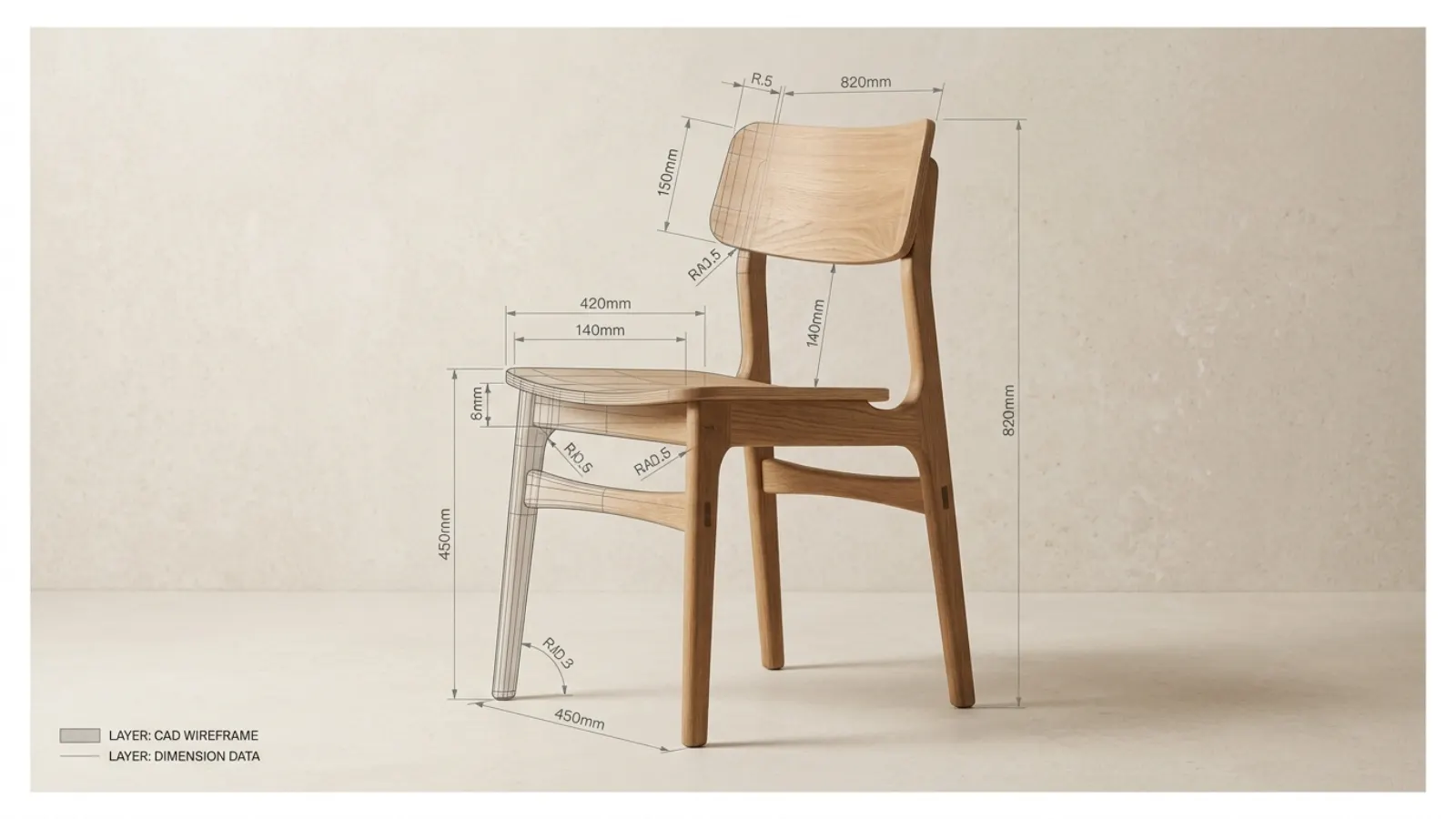
Dimensions tell AI something an image cannot
We've previously discussed why dimension images are so valuable in e-commerce.
They answer practical customer questions, but they also contain structured information about the product itself.
A photograph can suggest that a sofa is large.
A dimension tells you it is 96 inches wide.
Those aren't equivalent pieces of information.
If an AI system knows the actual dimensions of a sofa, coffee table and rug, it has a much stronger basis for placing those objects together at believable scale.
Instead of asking the model to estimate the relationship from visual appearance alone, we can give it the answer.
Again, we reduce the amount it needs to guess.
04
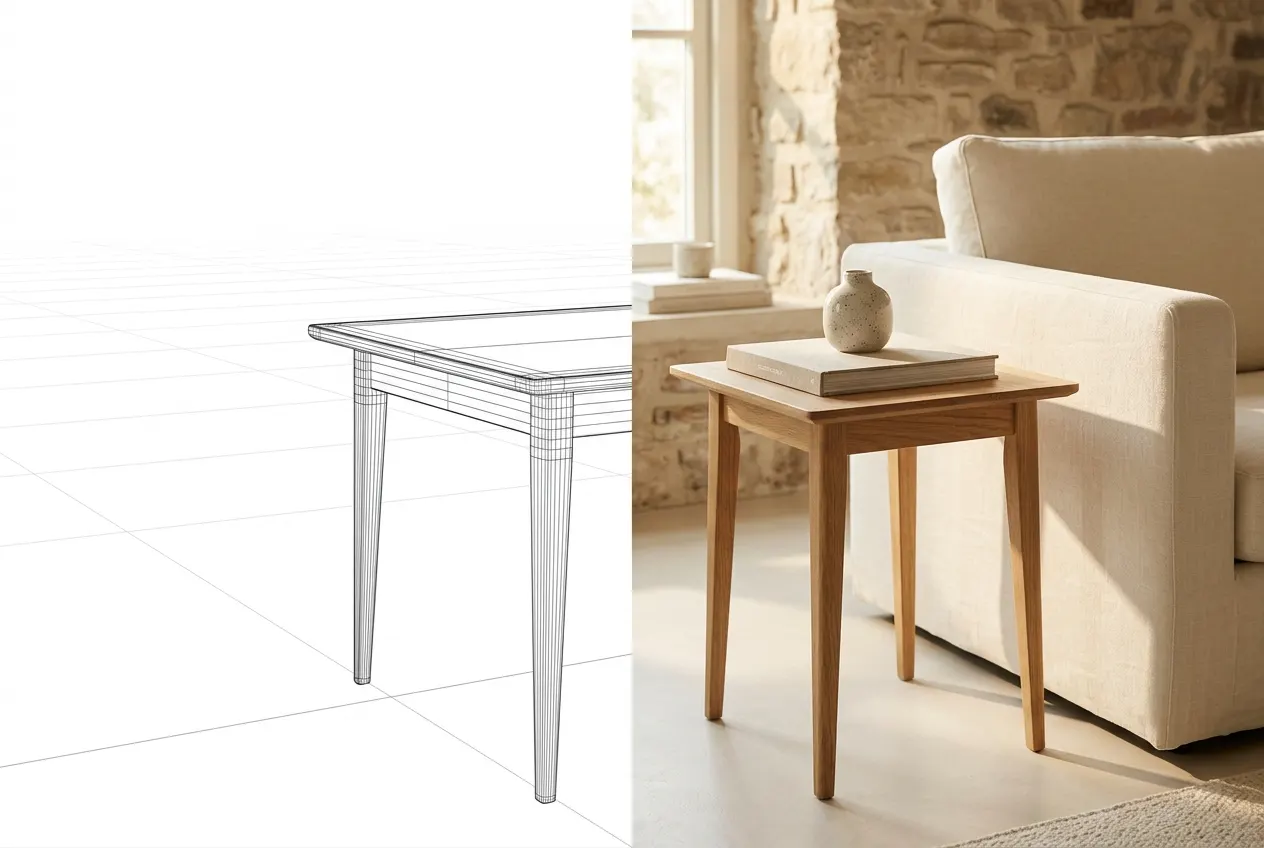
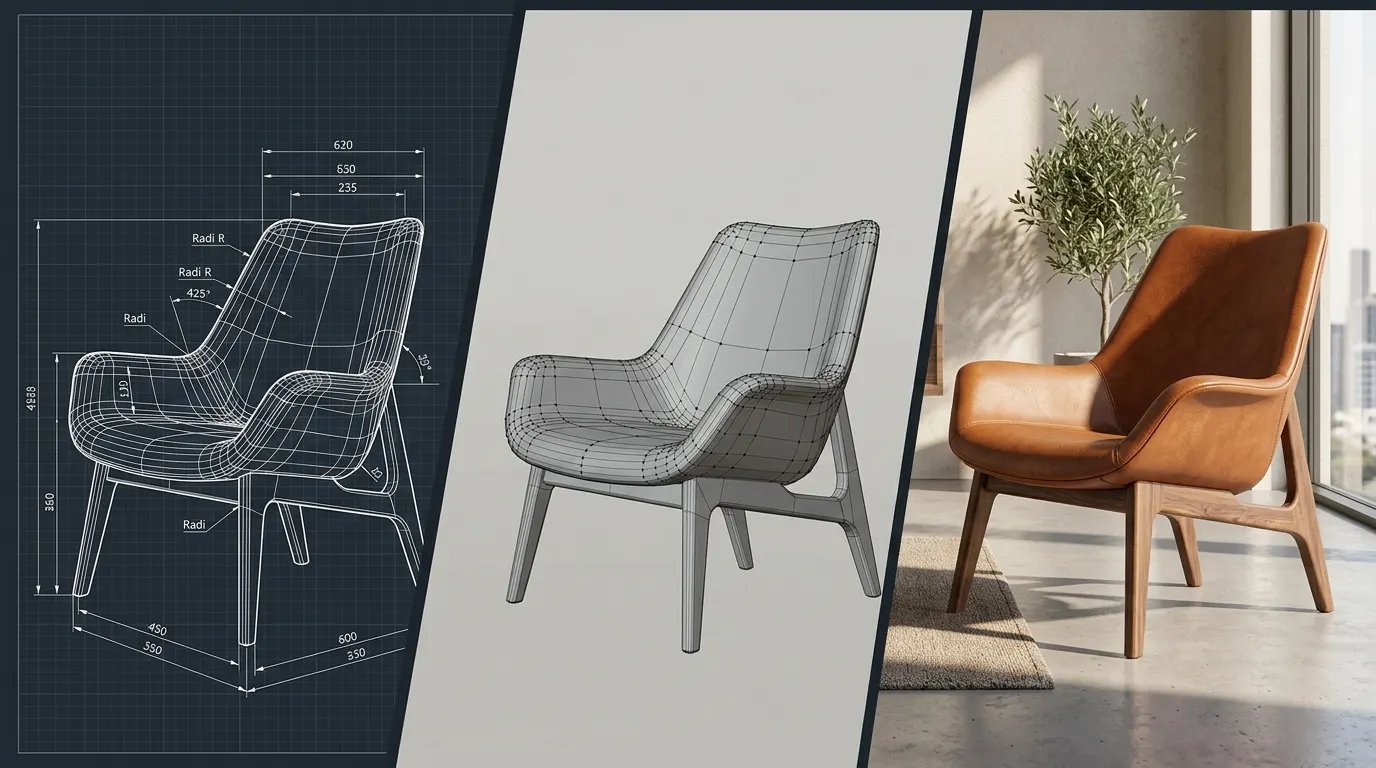
CAD tells AI about geometry
A 3D or CAD model provides another type of evidence.
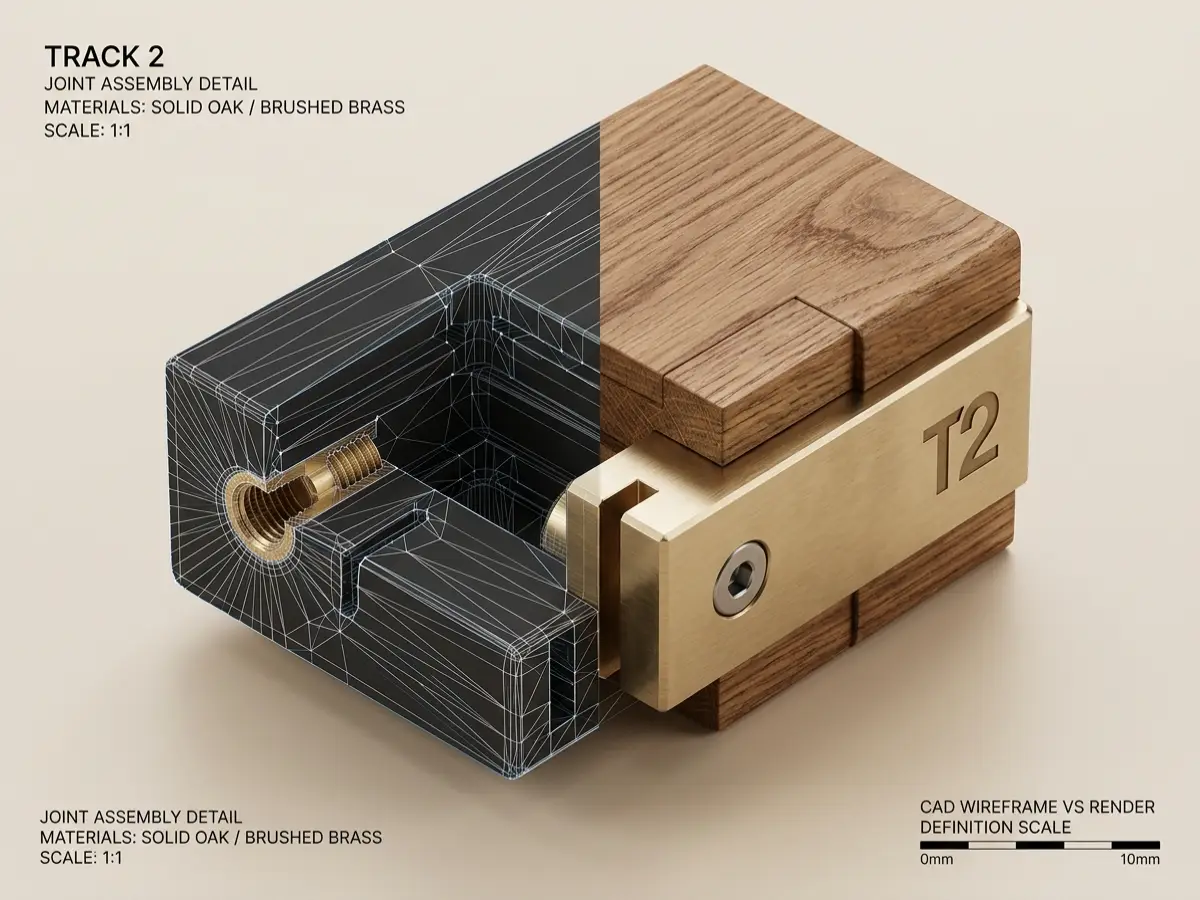
Instead of showing the AI several projections of a product and asking it to infer the form between them, we can potentially provide an explicit description of that three-dimensional geometry.
Now we know where the back of the sofa is.
We know how thick the tabletop is.
We know the position of the legs.
We know the radius on an edge.
This is one reason we do not see AI simply making 3D product data obsolete.
The more interesting future is likely one in which different kinds of product data work together.
Photography tells us something.
CAD tells us something else.
Dimensions add another layer.
Material information adds another.
And AI becomes the intelligence capable of interpreting those different forms of information together.
05
Assembly instructions describe how the product works
Assembly is an especially interesting and often overlooked source of product knowledge.
An assembly manual doesn't simply tell a customer how to put a piece of furniture together.
It describes relationships between components.
This panel connects to that panel.
These bolts fit these inserts.
This leg attaches at this location.
This component needs to be oriented in this direction.
In other words, assembly information describes how the product is constructed.
For an AI system trying to understand a product, that information could be enormously useful.
And once AI can understand assembly information, the value goes beyond generating imagery.
It could potentially identify confusing assembly steps.
It could compare customer service tickets with specific stages of assembly.
It could recognize that customers repeatedly install one component incorrectly.
It could help rewrite instructions.
Eventually, it could even feed those problems back into the design of the next product.
Now we are no longer talking about image generation.
We're talking about product intelligence.
06
Materials need their own information
Material accuracy remains one of the harder problems in digital product representation.
"Oak" isn't enough information.
Is it solid oak or veneer?
What is the grain direction?
What is the finish?
How reflective is the surface?
What happens at the edge?
Is there edge banding?
How does the fabric behave around a seam?
How thick is the pile?
Two materials can have almost identical colors while behaving completely differently under light.
For commercial product imagery, those differences matter.
An AI system that has access to actual material information has a much better chance of representing the product accurately than one trying to determine everything from a photograph.
07
Customer feedback is product information too
This is where the definition starts becoming much bigger.
Until now, we've mostly been talking about information created before the product reaches the customer.
But what happens afterward may be even more valuable.
Imagine a dining chair receives hundreds of reviews.
Customers repeatedly say that it looks beautiful.
They love the wood finish.
They think it feels more expensive than it is.
But a significant percentage mention that the seat feels too firm.
Those reviews contain product information.
Returns contain product information.
Customer service tickets contain product information.
Sales contain product information.
Even the search terms customers use before buying the product contain information about how they understand it.
Historically, much of that data has been analyzed separately.
AI creates the possibility of connecting it.
08
From product images to product knowledge
This is the larger shift taking place.
Right now, much of the conversation around generative AI in retail is focused on outputs.
Can it make this photograph?
Can it create this room?
Can it generate this video?
Those are useful questions.
But they may not be the most important ones.
The more interesting question is:
How much does the AI know about the product before we ask it to create anything?
Imagine two systems.
The first receives one photograph of a chair and a prompt.
The second has access to five product views, the CAD model, dimensions, materials, assembly instructions and technical specifications.
Ask both systems to generate the chair from a new angle.
Which one would you trust?
The difference isn't necessarily the image-generation model.
The difference is the quality of the product knowledge behind it.
09
What makes a product AI-ready?
We expect to hear this question much more frequently.
An AI-ready product isn't simply a product with a photograph attached to it.
It's a product whose information is structured, connected and accessible enough that intelligent systems can use it.
That doesn't necessarily mean every company needs perfect CAD models or sophisticated digital infrastructure tomorrow.
It means recognizing that product data has suddenly become much more valuable.
Every clean image.
Every accurate dimension.
Every material specification.
Every assembly instruction.
Every review.
Each adds another piece of evidence.
The more a company knows about its products, the more AI can eventually do with them.
And imagery may turn out to be only one of the first applications.
Because once all of this information begins to become connected, we're approaching something bigger than a digital asset.
We're approaching a digital representation of the entire product and everything we've learned about it.
We call that the virtual product.
And that is where product development is heading next.
Next: The Future of Product Development: The Rise of the Virtual Product →
Frequently asked questions
How does AI build an understanding of a physical product?
AI understands a product by processing structured evidence rather than merely viewing pictures. By combining multi-angle reference photos, CAD geometry, exact dimensions, material specifications, assembly manuals, and customer feedback, the system constructs an accurate multi-layered product definition.
Why are dimensions important for AI product placement?
Physical dimensions provide numerical constraints that prevent scale distortion. While an image only suggests relative size, explicit dimensions allow AI to position products alongside complementary furniture and architecture at correct, believable real-world proportions.
How does CAD data help AI generate accurate product visuals?
CAD models provide explicit three-dimensional geometry, establishing exact part positions, edge radii, panel thicknesses, and joint locations. This removes the need for AI to infer or guess three-dimensional form from flat two-dimensional projections.
Why are assembly instructions useful for AI product intelligence?
Assembly instructions define how components relate structurally and mechanically. AI can use this data to understand construction logic, diagnose recurring assembly difficulties in customer service tickets, and inform future product design improvements.
Why does AI need specific material data beyond color?
Materials with identical colors can have completely different reflectance, surface texture, pile thickness, grain direction, and edge treatments. Explicit material specifications ensure AI renders authentic surface behaviour under varying lighting conditions.
What makes a physical product AI-ready?
A product is AI-ready when its visual, dimensional, material, structural, and performance data is structured and connected across systems, allowing AI models to accurately visualize, evaluate, and merchandise the item without guessing.
Continue with the next question: Why do standard AI product images look fake? →