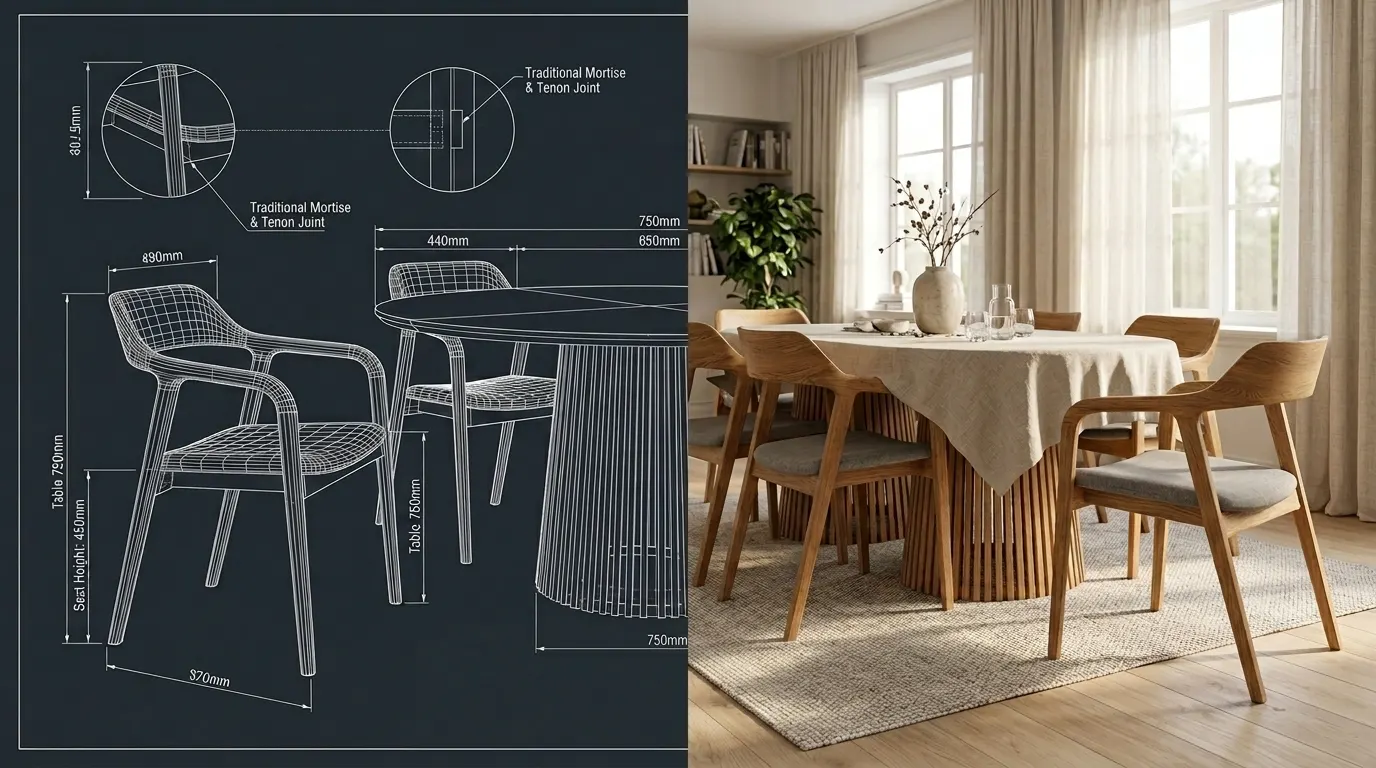
A physical product does not need to exist before commercial imagery can begin. What needs to exist is a reliable definition of the product.
That definition can include:
- Geometry, dimensions & proportions
- Construction, materials & finishes
- Hardware & components
- Approved design decisions
From that asset, teams can begin creating product imagery, room scenes, finish and colorway variations, buyer presentations, assortment boards, showroom visualizations, 360° views, AR experiences, configurators, ecommerce assets, and campaign content, while engineering and manufacturing continue in parallel.
The important question isn’t “has the product been manufactured yet?” It’s “do we know enough about the product to represent it truthfully?”
Product truth comes before product imagery
Creating imagery before manufacturing does not mean guessing what the product might look like. It means identifying which parts of the product are already sufficiently defined to be trusted, for example:
- Is the geometry approved?
- Are the dimensions reliable?
- Is the construction understood?
- Has the hardware been selected?
- Are the materials known, and are finishes approved or still provisional?
- Which details are final, and which are still expected to change?
The more of the product that is known, the more confidently it can be represented digitally. This is one reason good product design and engineering matter so much to early visualization: they create the constraints that prevent CGI, and increasingly AI, from drifting away from the real product.
The goal is not to make a convincing image of a product that does not exist. The goal is to create an accurate digital representation of a product that has been sufficiently defined to exist.
Why does this matter?
Traditional product photography depends on a physical object. The product typically has to be:
- designed
- engineered
- manufactured
- finished
- shipped
- assembled
- delivered to a studio
before photography can begin, a long chain of dependencies. Meanwhile, commercial teams may already need imagery for ecommerce, catalogues, retailer presentations, trade shows, sales meetings, assortment reviews, showrooms, packaging, advertising, launch campaigns, and internal approvals. If all of those activities have to wait for finished samples, visualization can become a bottleneck.
With a well-managed digital workflow, commercial preparation can begin while manufacturing continues. The goal is not simply to make images faster. It is to reduce the time between product development and market readiness.
What do you need before CGI can begin?
You do not necessarily need a finished production sample. You do need enough reliable information to define the product at the level required by the image. Useful inputs can include:
CAD / STEP files & engineering drawings
Dimensions & technical drawings
Sketches & product specifications
Material & finish references
Prototype & sample photographs
Hardware, brand & image standards
The quality of the output depends heavily on the quality of the source information.
CAD is often the strongest starting point
If engineering CAD already exists, it can provide an authoritative foundation for early visualization, establishing overall dimensions, geometry, component relationships, assembly structure, hardware positions, wall thicknesses, construction details, tolerances, and repeatable product variants. The CAD may still require preparation before rendering. But it gives the visualization process something extremely valuable: constraint. Instead of asking a rendering system to invent what seems plausible, the product is grounded in information that has already been resolved through design and engineering.
Constraints make digital images more believable
One of the risks of CGI and AI is that almost anything is possible. That freedom can produce beautiful images that still feel wrong:
- A room can contain impossible proportions.
- A product can subtly change shape between images.
- Hardware can move, and materials can behave incorrectly.
- Edges can become too thin.
- A chair can float.
- A cabinet can gain doors that were never designed.
Real product information creates guard rails. Accurate geometry, dimensions, materials, construction, and finish specifications reduce the number of things the visualization process is allowed to invent. That does not limit creativity: it creates a reliable space in which creativity can happen.
Three accuracy gates
Not every image created before manufacturing needs the same level of certainty. A useful way to manage the process is to distinguish between three stages.
Conceptual visualization
Useful while the product is still being explored, it may support decisions about direction, proportion, style, collection concept, colour, finish, merchandising, or environment. Some details may still change. The image is helping the team decide what the product should become.
Design-accurate visualization
At this stage the primary product definition is established: approved geometry, reliable dimensions, intended materials, major hardware, product proportions, current engineering, and known finish direction. Useful for internal approvals, retailer presentations, showroom planning, assortment reviews, range boards, and early marketing preparation. The product may still change, but the image reflects the current approved design.
Production-validated visualization
Customer-facing ecommerce imagery requires the highest level of confidence: final geometry, final dimensions, production hardware, approved materials and finishes, final construction, current product revisions, and the manufactured product where validation is available. The closer the image gets to a purchase decision, the more important this accuracy becomes.
What decision is the image supposed to support?
This is one of the most useful questions in the workflow.
What decision is this image supposed to support?
If the image is for an internal design review, the product can still be fluid. If it’s being used to decide an assortment or present a proposed collection to a retailer, the product should be more developed. If it’s going onto a product detail page where a customer will make a purchase decision, the underlying product definition should be highly mature and validated. The technology may be the same. The required accuracy is not.
What if the product is still changing?
That is normal. Visualization can begin while the design is still developing. But the model should be managed as part of the product-development system: revisions documented, approved versions identifiable, outdated geometry replaced, finish changes tracked, engineering updates communicated, and imagery synchronized with the current approved product.
Product visualization can improve the product before manufacturing
There’s another advantage to building the product digitally before production: visualization can reveal issues that are difficult to see in drawings alone. A realistic digital representation may expose proportion problems, awkward gaps, hardware placement, inconsistent radii, material conflicts, styling issues, visual imbalance, finish combinations, collection inconsistencies, and scale problems within an environment. This does not replace engineering validation: it provides another way of seeing the product before tooling and production lock in expensive decisions. Sometimes the image is not merely documenting the product. It helps the team understand the product.
Furniture is a good example
Imagine a new Home & Living collection being prepared for launch. The factory may still be completing tooling, sourcing materials, refining finishes, and building prototypes. Meanwhile, the commercial team may already need to show the collection to retail buyers, distributors, sales representatives, ecommerce teams, marketing teams, showroom teams, and internal merchandising teams.
If the products have sufficiently developed CAD, engineering, material, and finish information, Vux & Hoy can begin building trusted digital product assets before all finished products physically exist, supporting white-background product images, detail views, room scenes, finish variations, coordinated collection imagery, range boards, buyer presentations, showroom concepts, retail visualizations, 360° views, AR, and ecommerce assets.
This becomes more valuable across large assortments
The economics change dramatically when a collection contains many SKUs. Imagine trying to physically photograph 50 products in 5 finishes across several configurations, multiple camera angles, and retailer-specific assortments: the number of physical combinations grows quickly.
A controlled digital product system can make it possible to reuse approved assets across many commercial outputs. One master product may support multiple finishes, alternative materials, different configurations, multiple room scenes, different retailers, different camera angles, and future campaigns. That doesn’t mean every variation becomes automatic. It means the work no longer has to start from zero each time.
You can test finishes before manufacturing every variation
Digital visualization can also help teams evaluate proposed materials and finishes before committing to every physical variation. One sideboard, for example, might be reviewed in natural oak, walnut, black oak, a painted finish, or alternative hardware, supporting decisions about assortment balance, collection consistency, CMF direction, merchandising, buyer presentations, showroom planning, retailer-specific ranges, and campaign direction.
CGI should not replace physical material approval: real-world materials can behave differently from their digital representations. But digital visualization can help narrow decisions before every option is sampled physically.
You can test commercial ideas before full production
In some B2B environments, early digital product development can change how products are sold. A manufacturer may need to present a proposed collection to buyers before committing to full production. A trusted digital product system can support buyer presentations, assortment boards, showroom concepts, room environments, finish options, product imagery, and collection stories, allowing commercial teams to test interest before manufacturing every proposed SKU. Visualization becomes part of product and assortment development, not simply something that happens after the product is finished.
CGI does not mean guessing
Creating imagery before manufacturing does not mean filling in unknown information and hoping it is correct. A disciplined workflow identifies what is confirmed, what is provisional, and what is unknown. Unknown information should be resolved before the imagery is treated as product-accurate, particularly important for ecommerce and other customer-facing content.
AI makes this distinction even more important. Generative systems are very good at inventing plausible details. Professional product visualization requires knowing which details the system is not allowed to invent.
A practical example
Imagine a new sideboard. The manufacturer has approved dimensions, engineering CAD, a finalized door configuration, selected hardware, and an approved walnut finish, but no finished production sample yet. That may be enough information to begin producing highly accurate digital product assets.
Meanwhile, the physical product continues toward manufacturing. When the production sample arrives, the digital product can be validated against it before final customer-facing imagery is approved.
Frequently asked questions
Can you make product images without having the physical product?
Yes. If sufficient information exists to define the product accurately, CGI can often be created before a physical production sample exists.
Do you need CAD?
Not always. CAD is extremely useful, but visualization can also be created from combinations of drawings, dimensions, sketches, photographs, specifications, and references. The required information depends on the product and the level of accuracy the image needs to achieve.
Can you create ecommerce images before production?
Yes, but the underlying product definition should be sufficiently mature. Customer-facing ecommerce imagery requires a much higher level of confidence than an internal concept image. Final imagery should be validated against the latest approved production information and, when available, the physical production product.
What happens if the product changes?
The 3D model should be revised. A well-managed workflow tracks product revisions so imagery remains synchronized with the latest approved product.
Can CGI help us decide which products to manufacture?
It can support that decision. CGI can visualize proposed products, finishes, assortments, and merchandising before every variation has been physically produced, useful for buyer presentations, assortment planning, internal review, CMF decisions, retailer-specific ranges, and market testing.
Can we show retail buyers products before samples exist?
Yes. Early-stage product visualization is particularly useful for buyer presentations and assortment reviews. The imagery should reflect the current approved design, and its accuracy stage should be understood internally.
Can you visualize an entire collection before manufacturing it?
Potentially, yes. If the collection has sufficiently defined product information, a digital product system can be created for multiple products, finishes, and configurations, particularly valuable when preparing large collections for retail presentations, showrooms, ecommerce, sales meetings, and assortment planning.
Does CGI replace physical prototypes?
No. Physical prototypes may still be necessary for engineering, comfort testing, structural validation, manufacturing verification, material approval, and quality control. CGI solves a different problem: it allows the product to be seen, evaluated, communicated, and commercialized digitally before every physical asset exists.
Should we wait until the design is final?
Not necessarily. Visualization can begin during development. The important thing is to know whether the imagery is conceptual, design-accurate, or production-validated. That determines what decisions the image should be trusted to support.
You don’t always have to wait for manufacturing to start commercial preparation. When enough accurate product information exists, design, engineering, digital product development, manufacturing, and commercial content can begin to work as one connected system.
The result isn’t simply earlier imagery. It’s a more connected path from product strategy to design & engineering to manufactured reality to market readiness.
Related work: Furniture ideas shown as room scenes, isolated products, detail boards and a lighting study. The ideas were not selected for production.See the Product CGI story →
Your product doesn’t have to be finished to start the conversation.
- CAD, drawings, dimensions & specifications
- Finish references & sketches
- Whatever reliable product information currently exists
We’ll tell you what’s already defined, what still needs resolving, what level of accuracy is possible now, and how early the commercial asset pipeline can begin.